MCQ
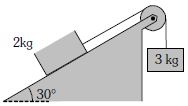
In the arrangement shown, the $2\, kg$ block is held to keep the system at rest. The  string and pulley are ideal. When the $2\, kg$ block is set free, by what amount the  tension in the string changes? $[ g = 10\, m/s^2]$
  • A
    Increase of $12\, N$
  • Decrease of $12\, N$
  • C
    Increase of $18\, N$
  • D
    Decrease of $18\, N$

Answer

Correct option: B.
Decrease of $12\, N$
b
$\mathrm{T}_{1}=3 \mathrm{g}=3 \times 10=30 \mathrm{N}$

$a=\frac{3 g-2 g \sin 30^{\circ}}{3+2}$

$=\frac{\left(3-2 \times \frac{1}{2}\right) \times 10}{5}=2 \times 2=4 \mathrm{m} / \mathrm{s}^{2}$

$\mathrm{T}_{2}=3(\mathrm{g}-\mathrm{a})$

$=3(10-4)=18 \mathrm{N}$

$\therefore$ change $\Delta \mathrm{T} \Rightarrow \mathrm{T}_{2}-\mathrm{T}_{1}=18-30=-12 \mathrm{N}$

$\Delta \mathrm{T}=12 \mathrm{N}(\text { decrease })$

Need a full question paper?

Generate a complete, print-ready paper with questions like this in minutes — across 16+ boards, with answer keys.

Start Generating Free

Similar questions

A solid cylinder of mass $50\, kg$ and radius $0.5\, m $ is free to rotate about the horizontal axis. A massless string is wound round the cylinder with one end attached to it and other hanging freely. Tension in the string required to produce an angular acceleration of $2$ revolutions $s^{-2}$ is ...... $N$
In figure, two blocks $M$ and $m$ are tied together with an inextensible and light string. The mass $M$ is placed on a rough horizontal surface with coefficient of friction $\mu$ and the mass $m$ is hanging vertically against a smooth vertical wall. The pulley is frictionless. When the downward acceleration of the elevator becomes equal to $g$, then
Physical independence of force is a consequence of:
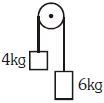
Two bodies of mass $4 \,kg$ and $6\, kg$ are tied to the ends of a massless string. The string passes over a pulley which is frictionless (see figure). The acceleration of the system in terms of acceleration due to gravity $(g)$ is 
The given quantity of an ideal gas is at pressure $P$ and absolute Temperature $T.$ The isothermal bulk Modulus of the gas is:
Agas expands such that its initial and final temperature are equal. Also, the process followed by the gas traces a straight line on the $P-V$ diagram :
A cube has numerically equal volume and surface area. The volume of such a cube is  ........... $units$
In a practical unit if the unit of mass becomes double and that of unit of time becomes half, then $8$ joule will be equal to .............. unit of work.
$12\,\,gms$ of gas occupy a volume of $4\times 10^{-3}\,\, m^3$ ata temperature of $7\,^oC$. After the gas is heated at constant pressure its density becomes $6\times 10^{-4}\,\,gm/cc$. ...... $K$ temperature to which the gas was heated.
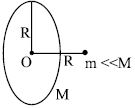
A particle starts from rest at a distance $R$ from the centre and along the axis of a fixed ring of radius $R \&$ mass $M.$ Its velocity at the centre of the ring is :