Question
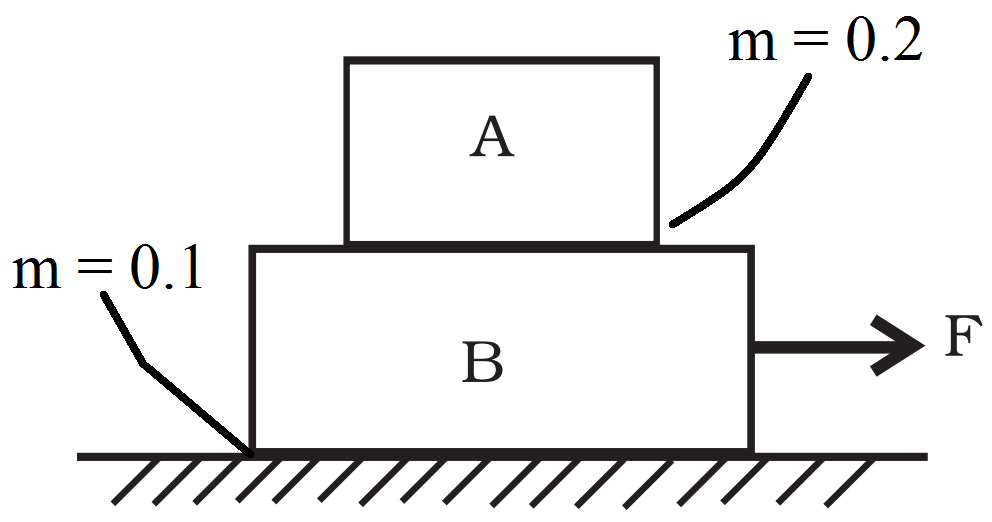
In the $co-$efficient of friction between the floor and the body $B$ is $0.1.$ The $co-$efficient of friction between the bodies $B$ and $A$ is $0.2. \ A$ force $F$ is applied as shown on $B.$ The mass of $A$ is $m^2$ and of $B$ is $m.$ Which of the following statements are true?
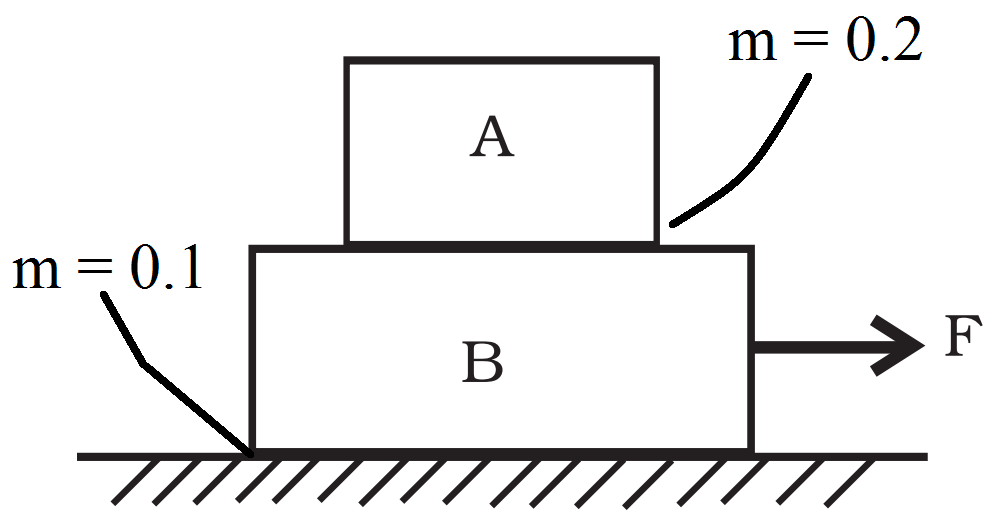
  1. a The bodies will move together if $F = 0.25\ mg.$
  2. The body $A$ will slip with respect to $B$ if $F = 0.5\ mg.$
  3. The bodies will be at rest if $F = 0.1\ mg.$
  4. The maximum value of $F$ for which the two bodies will move together is $0.45\ mg.$
Answer

  1. When there is no friction
  1. $B$ will move with acceleration $(F/M)$ while $A$ will remin at rest $($relative to ground$)$ as there is no pulling force on $A.$
$\text{a}_\text{B}=\Big(\frac{\text{F}}{\text{M}}\Big)$ And $\text{a}_\text{A}=0$
  1. As relative to $B, A$ will move backwards with acceleration $(F/M)$ and so will fall from it in time $t.$
$\therefore \text{t}=\sqrt{\frac{2\text{ML}}{\text{F}}}=\sqrt{\frac{2\text{ML}}{\text{F}}}$
  1. If friction is present between $A$ ans $B$ only and $F < F_1$
  1. Pseudo force on the body $A,$
$\text{F}'=\text{ma}=\frac{\text{mF}}{\text{m+M}}$ and $\text{F}_\text{I}=\mu_\text{s}\ \text{mg}$
  1. $\text{F}'<\text{F}_\text{I}\Rightarrow\frac{\text{m}\text{F}}{\text{m}+\text{M}}<\mu_s\ \text{mg}$
$\Rightarrow \text{F}<\mu_\text{s}(\text{m}+\text{M})\text{g}$
So both bodies will move together with acceleretion $\text{a}_\text{A}=\text{a}_\text{B}$
$=\frac{\text{F}}{\text{m}+\text{M}}$ if $\text{F}<\mu_\text{s}[\text{m}+\text{M}]\text{g}$
  1. If friction is present betveen $A$ and $B$ only and $f > \text{F}_I' ($where $\text{F}_I'= \mu_\text{s}\ \text{mg}=$ limiting friction between body $A$ and $B)$
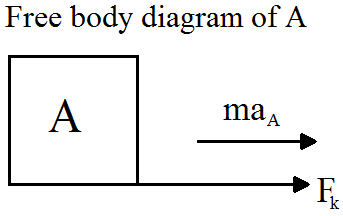
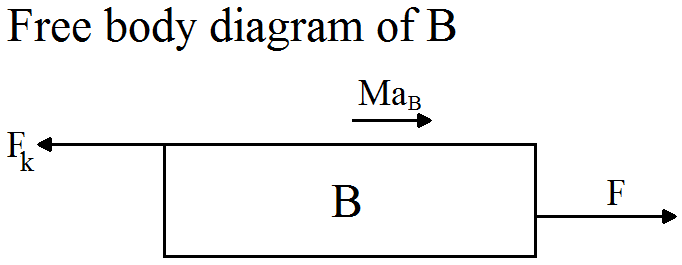
Both the body will move with different acceleratio. here force of kinetic frition $\mu_\text{k}\ \text{mg}$ will oppose the motion of $B$ which will cause the motion of $A.$
$\text{ma}_\text{A}=\mu_\text{k}{\text{mg}}$
$\text{i.e.}\text{a}_\text{A}=\mu_\text{k}\text{g}$
$\text{F}-\text{F}_\text{k}=\text{Ma}_\text{B}$
$\text{i.e.}\ \text{a}_\text{B}=\frac{[\text{F}-\mu_\text{k}\text{mg}]}{\text{M}}$
Note: As both the bodies are moving are moving the same direction, Acceleration of body $A$ relative to $B$ will be:
$​\text{a}=\text{a}_\text{A}-\text{a}_\text{B}=-\Big[\frac{\text{F}-\mu_\text{k}\text{g}(\text{m}+\text{M})}{\text{M}}\Big]$
Negative sign implies thet relative to $B, A$ will move backword and will fall it after time $t.$
$=\sqrt{\frac{2\text{L}}{\text{a}}}=\sqrt{\frac{2\text{ML}}{\text{F}-\mu_\text{k}\text{g}(\text{m}+\text{M})}}$
  1. If there is friction between $B$ and floor and $"F > F_1"$ 
$($where $\text{F}_\text{1} =\mu_\text{s}(\text{m}+\text{M})\text{g}=$ limiting friction between body $B$ and surface$)$
The system will move only if $"F > F_1"$ then replacing $F$ by $"F - F_1".$
the entrire case $(iii)$ will be valid.
However if $"F < F_1"$ the system will not move and friction between $B$ and floor will be $F$ while between $A$ and $B$ is zero.
To here first we have to find first frictional forces on each surface and accordingly we will decide maximum force.
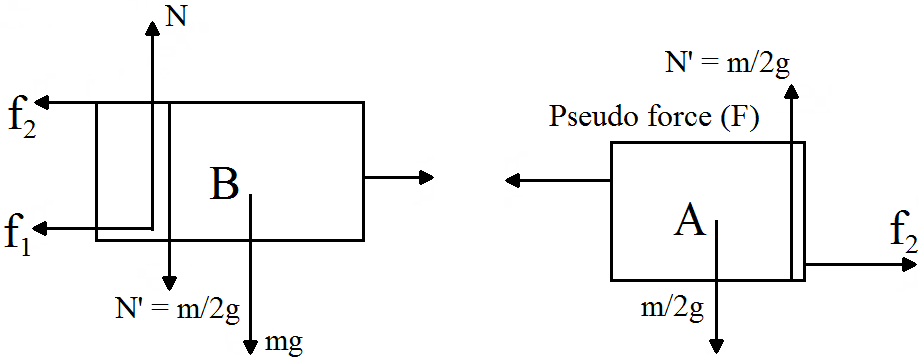
The friction force always have tendency to oppose the motion. In the given diagram, let the frictional force between floor and block $B$ is $(f_1)$ and frictional force between block $B$ and $A$ is $(f_2)$ will be as shown.
Let $A$ and $B$ are moving together.
$\text{a}_{\text{common}}=\frac{\text{F}-\text{f}_1}{\text{M}_\text{A}+\text{M}_\text{B}}=\frac{\text{F}-\text{f}_1}{(\text{m}/2)+\text{m}}=\frac{2(\text{F}-\text{f}_1)}{3\text{m}}$
Pseudo force on $\text{A}=(\text{m}_\text{A})\times\text{a}_\text{common}$
$=\text{m}_\text{A}\times\frac{2(\text{F}-\text{f}_1)}{3\text{m}}=\frac{\text{m}}{2}\times\frac{2(F-\text{f}_1)}{3\text{m}}=\frac{(\text{F}-\text{f}_1)}{3}$

The force $(F)$ will be maximam when the blocks are moved together, then pseudo force on $A =$ fritional force on $A$
$\frac{\text{F}_\text{max}-\text{f}_1}{3}=\mu\text{m}_\text{A}\ \text{g}=0.2\times\frac{\text{m}}{2}\times\text{g}=0.1\ \text{mg}$
$\Rightarrow\ \text{F}_\text{max}=0.3\ \text{mg}+\text{f}_1$
$=0.3\ \text{mg}=(0.1)\frac{3}{3}\ \text{mg}=0.45\ \text{mg}$
Similarly, we can find up towgich bodies will move together is $\text{F}_\text{max}=0.45\ \text{mg}$
  1. Hence, for $\text{F}=0.25\ \text{mg}< \text{F}_\text{max}$ bodies will move together.
  2. For $\text{F}=0.5\ \text{mg}>\text{F}_\text{max},$ body $A$ will slip with respecct to $B.$
  3. For $\text{F}=0.5\ \text{mg}>\text{F}_\text{max},$ bodies slip.
$(\text{f}_1)_\text{max}=\mu_\text{B}\text{g}=(0.1)\times\frac{3}{2}\times\text{m}\times\text{g}=0.15\ \text{mg}$
$(\text{f}_2)_\text{max}=\mu_\text{A}\text{g}=(0.2)\Big(\frac{\text{m}}{2}\Big)(\text{g})=0.1\ \text{mg}$
Hence, minimum force required, so that both the blocks will move together,
$\text{F}_\text{min}=(\text{f}_1)_\text{max}+(\text{f}_2)_\text{max}$
$=0.15 \ \text{mg}+0.1\ \text{mg}$
$=0.25\ \text{mg}$
  1. According to the problam, force $\text{F}=0.1\ \text{mg}<\text{F}_\text{min}$
Hence, the bodies will be at rest.
  1. Maximum force for combined movement $\text{F}_\text{max}=0.45\ \text{mg.}$
 

Need a full question paper?

Generate a complete, print-ready paper with questions like this in minutes — across 16+ boards, with answer keys.

Start Generating Free

Similar questions

Measure of two quantities along with the precision of respective measuring instrument is: $\text{A} = 2.5\text{ms}^{-1} \pm 0.5\text{ms}^{-1}$ $\text{B} = 0.10\text{s} \pm 0.01\text{s}$ The value of $A B$ will be,
If a bimetallic strip is heated, it will
A circular loop of area $1 \mathrm{~cm}^2$, carrying a current of $10 A$ , is placed in a magnetic field of $0.1 T$ perpendicular to the plane of the loop. The torque on the loop due to the magnetic field is:
Determine coefficient of performance of given temperature limit.

$T_{1}=27^{\circ} C$ [outside fridge]

$T_{2}=-23^{\circ} C$ [inside fridge]

The initial angular velocity of a circular disc of mass $M$ is $\omega_1$ A small sphere of mass $m$ is attached gently on edge of the disc. The final angular velocity of the disc will be:
A planet of mass $M$, has two natural satellites with masses $m _1$ and $m _2$. The radii of their circular orbits are $R_1$ and $R_2$ respectively. Ignore the gravitational force between the satellites. Define $v _1, L _1, K _1$ and $T _1$ to be, respectively, the orbital speed, angular momentum, kinetic energy and time period of revolution of satellite $1$ ; and $v_2, L_2, K _2$ and $T _2$ to be the corresponding quantities of satellite $2$ . Given $m _1 / m _2=2$ and $R _1 / R _2=1 / 4$, match the ratios in List-$I$ to the numbers in List-$II$.
List-$I$ List-$II$
$P$ $\frac{ v _1}{ v _2}$ $1$ $\frac{1}{8}$
$Q$ $\frac{ L _1}{ L _2}$ $2$ $1$
$R$ $\frac{ K _1}{ K _2}$ $3$ $2$
$S$ $\frac{ T _1}{ T _2}$ $4$ $8$
A capillary tube of radius $0.2\,cm$ is dipped vertically in a beaker containing liquid. If the liquid rises to a height of $5\,cm$ for which the angle of contact is $60^o$ , then surface tension of the liquid is ...... $dynes/cm$ $(d = 1\,gm/cm^3)$
If $a$ cylinder is rolling down the incline with sliding.
A tank with a small hole at the bottom has been filled with water and kerosene (specific gravity $0.8$). The height of water is $3\,m$ and that of kerosene $2\,m$. When the hole is opened the velocity of fluid coming out from it is nearly ........ $ms^{-1}$ .(take $g\, = 10\, m s^{-2}$ and density of water $= 10^3\, kg\, m^{-3}$)
If the overbridge is concave instead of being convex, the thrust on the road at the lowest position will be