MCQ
In the coordinate valency
  • A
    Electrons are equally shared by the atoms
  • Electrons of one atom are shared with two atoms
  • C
    Hydrogen bond is formed
  • D
    None of the above

Answer

Correct option: B.
Electrons of one atom are shared with two atoms
b
The $2$ electrons of an atom ( generally lone pair) is donated by one atom to the other atom and it results in the formation of a coordinate bond. A chemical bond between two atoms in which a shared pair of electrons forms the bond and the pair has been supplied by one of the two atoms.

Need a full question paper?

Generate a complete, print-ready paper with questions like this in minutes — across 16+ boards, with answer keys.

Start Generating Free

Similar questions

Among the following species which two have trigonal pyramidal shape ?

$(I)$ $NI_3$                    $(II)$ $I_3^-$   

$(III)$ $SO_3^{-2}$         $(IV)$ $NO_3^-$

In which of the molecule $\pi-$ electrons are not delocalized ?
Calculate the heat of formation of $PC{l_5}(s)$ from the following data

$2P(s) + 3C{l_2}(g)\,\, \to \,\,2PC{l_3}(l);\,\Delta H = - 151.8\,kcal$

$PC{l_3}(l) + C{l_2}(g)\,\, \to \,\,PC{l_5}(s);\,\,\Delta H = - 32.8\,kcal$

......$kcal$

Tin is obtained from cassiterite by reduction with coke. Use the data given below to determine the minimum temperature (in $K$ ) at which the reduction of cassiterite by coke would take place.

At $ 298 K : \Delta_{ f } H ^{\circ}\left( SnO _2( s )\right)=-581.0 kJ mol ^{-1}, \Delta_{ fH } H ^{\circ}\left( CO _2( g )\right)=-394.0 kJ mol ^{-1}$

$S ^{\circ}\left( SnO _2( s )\right)=56.0 J K ^{-1} mol ^{-1}, S ^{\circ}( Sn ( s ))=52.0 J K ^{-1} mol ^{-1}$

$S ^{\circ}( C ( s ))=6.0 J K ^{-1} mol ^{-1}, S ^{\circ}\left( CO _2( g )\right)=210.0 J K ^{-1} mol ^{-1}$

Assume that the enthalpies and the entropies are temperature independent.

$2 \mathrm{SO}_{2}(\mathrm{~g})+\mathrm{O}_{2}(\mathrm{~g}) \rightleftharpoons 2 \mathrm{SO}_{3}(\mathrm{~g})$

In an equilibrium mixture, the partial pressures are

$P_{S O_{3}}=43\,\mathrm{kPa} ; \quad P_{O_{2}}=530 \,\mathrm{~Pa}$ and

$\mathrm{P}_{\mathrm{SO}_{2}}=45\, \mathrm{kPa}$ The equilibrium constant $\mathrm{K}_{\mathrm{p}}=......\times 10^{-2} .$ (Nearest integer)

The solubility of $AgCN$ in a buffer solution of $pH =3$ is $x$. The value of $x$ is

[Assume : No cyano complex is formed; $K _{ sp }( AgCN )$ $=2.2 \times 10^{-16}$ and $\left. K _{ a }( HCN )=6.2 \times 10^{-10}\right]$
The first four ionization energy values of an element are $191, 578, 872$ and $5962 \,k\,cal$. The number of valence electrons in the element is
The kinetic energy of an electron in the second Bohr orbit of a hydrogen atom is equal to $\frac{\mathrm{h}^{2}}{\mathrm{xma}_{0}^{2}}$. The value of $10 \mathrm{x}$ is ........ . $\left(\mathrm{a}_{0}\right.$ is radius of Bohr's orbit) (Nearest integer) [Given : $\pi=3.14]$
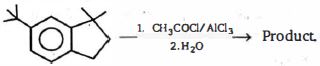
The major product of the reaction is
Which of the following react with $KMn{O_4}$ but does not react with $AgN{O_3}$?