In the circuit diagram of figure, $E = 5\, volt, r = 1\, \Omega ,$$ R_2 = 4\, \Omega , R_1 = R_3 = 1 \Omega$ and $C = 3\, μF.$ Then the magnitude of the charge on each capacitor plate is......$\mu C$
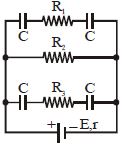
Medium


Download our appand get started for free
Experience the future of education. Simply download our apps or reach out to us for more information. Let's shape the future of learning together!No signup needed.*
Similar Questions
- 1The length of a wire of a potentiometer is $100\, cm$, and the $emf$ of its standard cell is $E\,volt$. It is employed to measure the $e.m.f$ of a battery whose internal resistance is $0.5 \,\Omega$. If the balance point is obtained at $l = 30\, cm$ from the positive end, the $e.m.f.$ of the battery isView Solution
where $i$ is the current in the potentiometer
- 2Incandescent bulbs are designed by keeping in mind that the resistance of their filament increases with the increase in temperature. If at room temperature, $100 \mathrm{~W}, 60 \mathrm{~W}$ and $40 \mathrm{~W}$ bulbs have filament resistances $\mathrm{R}_{100}, \mathrm{R}_{60}$ and $\mathrm{R}_{40}$, respectively, the relation between these resistances isView Solution
- 3In an experiment of potentiometer for measuring the internal resistance of primary cell a balancing length $\ell $ is obtained on the potentiometer wire when the cell is open circuit. Now the cell is short circuited by a resistance $R$. If $R$ is to be equal to the internal resistance of the cell the balancing length on the potentiometer wire will beView Solution
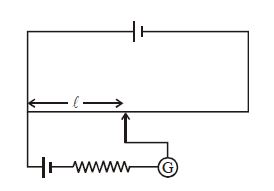
- 4In a potentiometer (see figure) a balance is obtained at a length of $400\ mm$ when using a known battery of emf $1.6\ V$. After removing this battery, another battery of unknown emf is used and balance is obtained at a length of $650\ mm.$ The emf of unknown battery is ............. $volt$View Solution
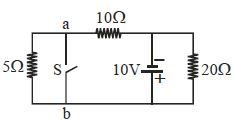
- 5In the circuit shown below, the current that flows from $a$ to $b$ when the switch $S$ is closed ............... $A$View Solution
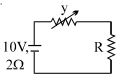
- 6In the figure shown the power generated in $y$ is maximum when $y = 5\,\Omega$ . Then $R$ is .............. $\Omega$View Solution
- 7$A$ uniform copper wire carries a current $i$ amperes and has $p$ carriers per meter$^3$. The length of the wire is $\lambda$ meters and its cross-section area is $s$ meter $^2$. If the charge on a carrier is $q$ coulombs, the drift velocity in $ms^{-1}$ is given byView Solution
- 8If current in an electric bulb changes by $1\%$, then the power will change by ............ $\%$View Solution
- 9Resistors of $1$, $2$, $ohm$ are connected in the form of a triangle. If a $1.5\, volt$ cell of negligible internal resistance is connected across $3\, ohm$ resistor, the current flowing through this resistance will be ................ $amp$View Solution
- 10An ammeter $A$ of finite resistance, and a resistor $R$ are joined in series to an ideal cell $C$. $A$ potentiometer $P$ is joined in parallel to $R$. The ammeter reading is $I_0$ and the potentiometer reading is $V_0$. $P$ is now replaced by a voltmeter of finite resistance. The ammeter reading now is $I$ and the voltmeter reading is $V$.View Solution
