MCQ
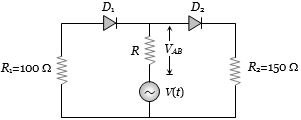
In the circuit given below, $V(t) $ is the sinusoidal voltage source, voltage drop $V_{AB}(t) $ across the resistance $R$  is
  • A
    Is half wave rectified
  • B
    Is full wave rectified
  • C
    Has the same peak value in the positive and negative half cycles
  • Has different peak values during positive and negative half cycle

Answer

Correct option: D.
Has different peak values during positive and negative half cycle
d
(d)In positive half cycle one diode is in forward biasing and other is in reverse biasing while in negative half cycle their polarity reverses, and direction of current is opposite through $R$  for positive and negative half cycles so out put is not rectified.
Since $R_1$ and $R_2$ are different hence the peaks during positive half and negative half of the input signal will be different.

Need a full question paper?

Generate a complete, print-ready paper with questions like this in minutes — across 16+ boards, with answer keys.

Start Generating Free

Similar questions

For ferromagnetic material, the relative permeability ($\mu_r$), versus magnetic intensity (H) has the following shape
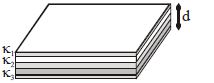
A parallel plate capacitor is filled with $3$ dielectric materials of same thickness, as shown in the sketch. The dielectric constants are such that $k_3 > k_2 > k_1$. Let the magnitudes of the electric field in and potential drops across each dielectric be $E_3$, $E_2$,$ E_1$, $\Delta V_3$, $\Delta V_2$ and $\Delta V_1$, respectively. Which one of the following statement is true ?
A thin rectangular magnet suspended freely has a period of oscillation equal to $T$. Now it is broken into two equal halves (each having half of the original length) and one piece is made to oscillate freely in the same field. If its period of oscillation is $T'$, the ratio $T'/T$ is :-
Electric lines of force about negative point charge are
A 2 MeV proton is moving perpendicular to a uniform magnetic field of 2.5 tesla. The force on the proton is
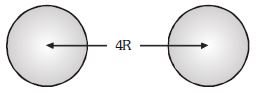
Two identical spheres each of radius $R$ are kept at center-to-center spacing $4R$ as shown in the figure. They are charged and the electrostatic force of interaction between them is first calculated assuming them point like charges at their centers and the force is also measured experimentally. The calculated and measured forces are denoted by $F_c$ and $F_m$ respectively.
($F_c$ and $F_m$ denote magnitude of force)
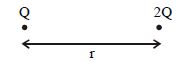
Mass of charge $Q$ is $m$ and mass of charge $2Q$ is $4\,m$ . If both are released from rest, then what will be $K.E.$ of $Q$ at infinite separation
In an inelastic collision:
A disk of radius $R$ with uniform positive charge density $\sigma$ is placed on the $x y$ plane with its center at the origin. The Coulomb potential along the $z$-axis is

$V(z)=\frac{\sigma}{2 \in_0}\left(\sqrt{R^2+z^2}-z\right)$

A particle of positive charge $q$ is placed initially at rest at a point on the $z$ axis with $z=z_0$ and $z_0>0$. In addition to the Coulomb force, the particle experiences a vertical force $\vec{F}=-c \hat{k}$ with $c>0$. Let $\beta=\frac{2 c \in_0}{q \sigma}$. Which of the following statement($s$) is(are) correct?

$(A)$ For $\beta=\frac{1}{4}$ and $z_0=\frac{25}{7} R$, the particle reaches the origin.

$(B)$ For $\beta=\frac{1}{4}$ and $z_0=\frac{3}{7} R$, the particle reaches the origin.

$(C)$ For $\beta=\frac{1}{4}$ and $z_0=\frac{R}{\sqrt{3}}$, the particle returns back to $z=z_0$.

$(D)$ For $\beta>1$ and $z_0>0$, the particle always reaches the origin.
A element used for radioactive carbon dating for more than 5600 years is