MCQ
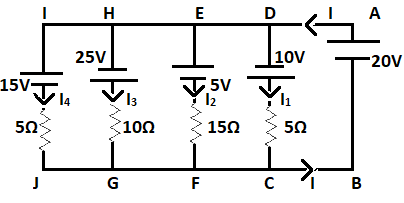
In the circuit shown below, calculate the current flowing through 20V cell.
- A12A
- B15A
- C12.5A
- D12.3A
Explanation:
Here, we can apply Kirchhoff’s loop rule in closed loops ADCBA, AEFBA, AHGBA, and AIJBA. Thus, we get
20 + 10 – 5I1 = 0 → I1 = 6A
-5 + 20 – 15I2 = 0 → I2 = 1A
25 + 20 – 10I3 = 0 → I3 = 4.5A
-15 + 20 – 5I4 = 0 → I4 = 1A
Therefore, the current flowing through the 20V cell = 6 + 1 + 4.5 + 1 = 12.5A
Generate a complete, print-ready paper with questions like this in minutes — across 16+ boards, with answer keys.
A plane mirror reflecting a ray of incident light is rotated through an angle θ about an axis through the point of incidence in the plane of the mirror perpendicular to the plane of incidence, then
|
(a) The reflected ray rotates through an angle 2θ |
| (b) The incident ray is fixed |
| (c) The reflected ray does not rotate |
| (d) a, b |
The wavelength of light visible to eye is of the order of
|
(a) |
(b) |
(c) 1 m |
(d) 6 |
Solar energy is mainly caused due to
|
(a) Fission of uranium present in the sun |
|
(b) Fusion of protons during synthesis of heavier elements |
|
(c) Gravitational contraction |
|
(d) Burning of hydrogen in the oxygen |
Monochromatic light of frequency 5  Hz travelling in vacuum enters a medium of refractive index 1.5. Its wavelength in the medium is
|
(a) 4000 Å |
(b) 5000 Å |
(c) 6000 Å |
(d) 5500 Å |
Two point charges Q and – 3Q are placed at some distance apart. If the electric field at the location of Q is E then at the locality of -3Q, it is
|
(a) - E |
(b) E/3 |
(c) -3E |
(d) -E/3 |
A charge produces an electric field of 1 N/C at a point distant 0.1 m from it. The magnitude of charge is
|
(a) 1.11 |
(b) 9.11 |
(c) 7.11 |
(d) None of these |


