MCQ
In the circuit shown below:
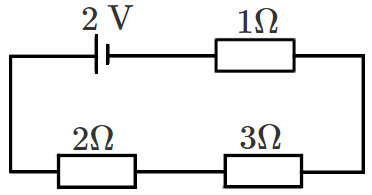
The potential difference across the $3 Ω$ resistor is:
The potential difference across the $3 Ω$ resistor is:
- A$\frac{1}{9}\text{V}$
- B$\frac{1}{2}\text{V}$
- C1V
- D2V
Explanation:
The resistors of $1 Ω, 2 Ω$ and $3 Ω$ are connected in series. Therefore, the net resistance,
$\text{R} = \text{R}_1 + \text{R}_2 +\text{R}_3$
$\text{R}=1\Omega+2\Omega+3\Omega=6\Omega$
Current in the circuit will be,
$\text{I}=\frac{\text{V}}{\text{R}}$
or $\text{I}=\frac{2}{6}=\frac{1}{3}\text{A}$
Current $=\frac{1}{3}\text{A}$
Therefore, the voltage across the 3I resistor,
V = IR
or $\text{V}=\frac{1}{3}\times3=1\text{V}$
Generate a complete, print-ready paper with questions like this in minutes — across 16+ boards, with answer keys.