In the circuit shown in figure, four capacitors are connected to a battery. The maximum energy is stored in the capacitor of.....$\mu F$
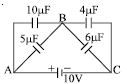
Diffcult
Download our app for free and get started

Download our appand get started for free
Experience the future of education. Simply download our apps or reach out to us for more information. Let's shape the future of learning together!No signup needed.*
Similar Questions
- 1In the following diagram the work done in moving a point charge from point $P$ to point $A$, $B$ and $C$ is respectively as $W_A$, $W_B$ and $W_C$ , thenView Solution
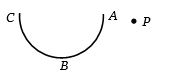
- 2A charge $+q$ is distributed over a thin ring of radius $r$ with line charge density $\lambda=q \sin ^{2} \theta /(\pi r)$. Note that the ring is in the $X Y$ - plane and $\theta$ is the angle made by $r$ with the $X$-axis. The work done by the electric force in displacing a point charge $+ Q$ from the centre of the ring to infinity isView Solution
- 3Consider a spherical shell of radius $R$ with a total charge $+ Q$ uniformly spread on its surface (centre of the shell lies at the origin $x=0$ ). Two point charges $+q$ and $-q$ are brought, one after the other from far away and placed at $x=-a / 2$ and $x=+a / 2( < R)$, respectively. Magnitude of the work done in this process isView Solution
- 4$27$ identical drops are charged at $22\, V\,\,each.$ They combine to form a bigger drop. The potential of the bigger drop will be............ $V.$View Solution
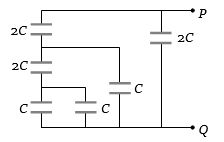
- 5View SolutionThe resultant capacitance of given circuit is
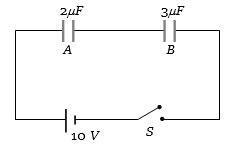
- 6Two capacitors $A$ and $B$ are connected in series with a battery as shown in the figure. When the switch $S$ is closed and the two capacitors get charged fully, thenView Solution
- 7A parallel plate air capacitor has a capacitance $C$. When it is half filled with a dielectric of dielectric constant $5$, the percentage increase in the capacitance will be.....$\%$View Solution
- 8$n$ identical condensers are joined in parallel and are charged to potential $V$. Now they are separated and joined in series. Then the total energy and potential difference of the combination will beView Solution
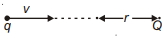
- 9The charge $q$ is fired towards another charged particle $Q$ which is fixed, with a speed $v$. It approaches $Q$ upto a closest distance $r$ and then returns. If $q$ were given a speed $2 v$, the closest distance of approach would beView Solution
- 10View SolutionThe capacity of a parallel plate capacitor increases with the