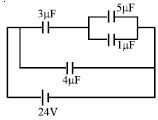
In the circuit shown, the energy stored in $1$ $ \mu F$ capacitor is......$\mu J$
Medium
Download our app for free and get started
Charge on $24 F=2 \times 24=48 \mu \mathrm{col}$
$q_{1}+q_{2}=48$
$\frac{q_{1}}{5}=\frac{q_{2}}{1} \quad q_{1}=5 q_{2}$
$6 q_{2}=48$
$q_{2}=8$
energy stored $=\frac{1}{2} \times \frac{Q^{2}}{C}=\frac{1}{2} \times \frac{8 \times 8}{1}=32 \mu J$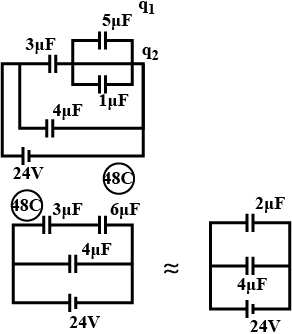

Download our appand get started for free
Experience the future of education. Simply download our apps or reach out to us for more information. Let's shape the future of learning together!No signup needed.*
Similar Questions
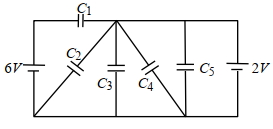
- 1In the following circuit $C_1=12 \mu F, C_2=C_3=4 \mu F$ and $C_4=C_5=2 \mu F$. The Charge stored in $C_3$ is. . . . . $\mu C$.View Solution
- 2View SolutionWhen a parallel plates capacitor is connected to a source of constant potential difference,
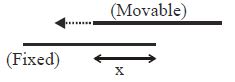
- 3A parallel-plate capacitor consists of a fixed plate and a movable plate that is allowed to slide in the direction parallel to the plates. Let $x$ be the distance of overlap, as shown in the figure. The separation between the plates is fixed. Assume that the plates are electrically isolated, so that their charges $±Q$ are constant. Force on the movable plate is proportional toView Solution
- 4View SolutionWhen a lamp is connected in series with capacitor, then
- 5Two charged parallel plate capacitors, each with separation between plates equal to $d$, are separated by a large distance $L >> d$. Then the force of interaction between them is proportional toView Solution
- 6The electric potential $V$ at any point $O$ ($x$, $y$, $z$ all in metres) in space is given by $V = 4{x^2}\,volt$. The electric field at the point $(1m,\,0,\,2m)$ in $volt/metre$ isView Solution
- 7A capacitor of capacitance $C$ is initially charged to a potential difference of $V$ $volt$. Now it is connected to a battery of $2V$ with opposite polarity. The ratio of heat generated to the final energy stored in the capacitor will beView Solution
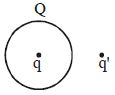
- 8A thin metallic spherical shell contains a charge $Q$ on it. A point charge $+q$ is placed at the centre of the shell and another charge $q'$ is placed outside it as shown in fig. All the three charges are positive. The force on the central charge due to the shell is :-View Solution
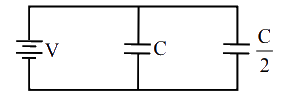
- 9Two condensers, one of capacity $C$ and other of capacity $C/2$ are connected to a $V-$ volt battery, as shown in the figure. The work done in charging fully both the condensers isView Solution
- 10The magnitude of electric field on the surface of a uniformly charged metalic spherical shell is $E$. If a hole is made in it using a insulating device, then the magnitude of electric field in the hole will beView Solution