MCQ
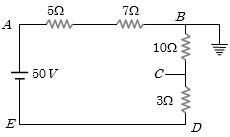
In the circuit shown, the point ‘$B$’ is earthed. The potential at the point ‘$A$’ is ............. $V$
  • A
    $14$
  • $24$
  • C
    $26$
  • D
    $50$

Answer

Correct option: B.
$24$
b
Current in the given circuit $i = \frac{{50}}{{(5 + 7 + 10 + 3)}} = 2\,A$

Potential difference between $A$ and $B$ ${V_A} - {V_B} = 2 \times 12$

$ \Rightarrow $ ${V_A} - 0 = 24\,V$ $ \Rightarrow $ ${V_A} = 24\,V$

Need a full question paper?

Generate a complete, print-ready paper with questions like this in minutes — across 16+ boards, with answer keys.
Start Generating Free

Similar questions

A uniform magnetic field of 0.4 T acts perpendicular to a circular copper disc 20 cm in radius. The disc is having a uniform angular velocity of $10 \pi \mathrm{rad} \mathrm{s}^{-1}$ about an axis through its centre and perpendicular to the disc. What is the protential difference developed between the axis of the disc and the rim ? $(\pi=3.14)$
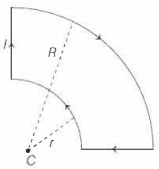
An arrangement with a pair of quarter circular coils of radii $r$ and $R$ with a common centre $C$ and carrying a current $I$ is shown in the figure. The permeability of free space is $\mu_0$. The magnetic field at $C$ is
A source of sound emitting a note of frequency $200 Hz$ moves towards an observer with a velocity $v$ equal to the velocity of sound. If the observer also moves away from the source with the same velocity $v$, the apparent frequency heard by the observer is .... $Hz$
The dimension of $\frac{1}{2} \varepsilon_0 E ^2$, where $\varepsilon_0$ is permittivity of free space and $E$ is electric field, is
A particle of mass $500 \,gm$ is moving in a straight line with velocity $v=b x^{5 / 2}$. The work done by the net force during its displacement from $x=0$ to $x =4 \,m$ is ...................$J$ (Take $b =0.25 \,m ^{-3 / 2} s ^{-1}$ )
Hydrogen atom is bombarded with electrons accelerated through a potential different of $\mathrm{V}$, which causes excitation of hydrogen atoms. If the experiment is being formed at $\mathrm{T}=0 \mathrm{~K}$. The minimum potential difference needed to observe any Balmer series lines in the emission spectra will be $\frac{\alpha}{10} \mathrm{~V}$, where $\alpha=$____________.
A train of $150$ metre length is going towards north direction at a speed of $10\; m / s$. A parrot flies at the speed of $5\; m / s$ towards south direction parallel to the railways track. The time taken by the parrot to cross the train is
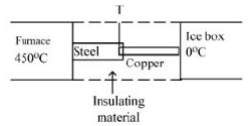
If $K_{1}$ and $K_{2}$ are the thermal conductivities $L_{1}$ and $L _{2}$ are the lengths and $A _{1}$ and $A _{2}$ are the cross sectional areas of steel and copper rods respectively such that $\frac{K_{2}}{K_{1}}=9, \frac{A_{1}}{A_{2}}=2, \frac{L_{1}}{L_{2}}=2$.

Then, for the arrangement as shown in the figure. The value of temperature $T$ of the steel - copper junction in the steady state will be ........... $^{\circ} C$
For three vectors $\vec{A}=(-x \hat{i}-6 \hat{j}-2 \hat{k})$, $\vec{B}=(-\hat{i}+4 \hat{j}+3 \hat{k})$ and $\vec{C}=(-8 \hat{i}-\hat{j}+3 \hat{k})$, if $\overrightarrow{\mathrm{A}} \cdot(\overrightarrow{\mathrm{B}} \times \overrightarrow{\mathrm{C}})=0$, them value of $\mathrm{x}$ is. . . . . .. 
Four ray $1, 2, 3$ and $4$ are incident normally on the face $P Q$ of an isosceles prism $P Q R$ with apex angle $\angle Q=120^{\circ}$. The refractive indices of the material of the prism for the above rays $1,2,3$ and $4$ are $1.85$, $1.95,2.05$ and $2.15$ respectively and the surrounding medium is air. Then, the rays emerging from the face $Q R$ are