MCQ
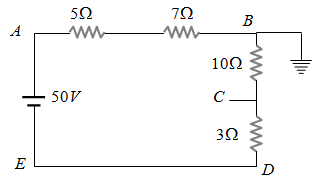
In the circuit shown, the point $‘B\ ’$ is earthed. The potential at the point $‘A\ ’$ is
  • A
    $14\ V$
  • $24\ V$
  • C
    $26\ V$
  • D
    $50\ V$

Answer

Correct option: B.
$24\ V$
$24\ V$

Need a full question paper?

Generate a complete, print-ready paper with questions like this in minutes — across 16+ boards, with answer keys.

Start Generating Free

Similar questions

In a photon-particle collision, the quantity that does not remain conserved is:
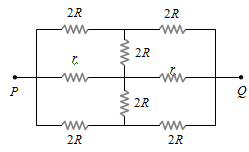
The effective resistance between points $P$ and $Q$ of the electrical circuit shown in the figure is
If two streams of protons move parallel to each other in the same direction, then they(a) Do not exert any force on each other(b) Repel each other(c) Attract each other(d) Get rotated to be perpendicular to each other


If the length of potentiometer wire is increased, then the length of the previously obtained balance point will:
A galvanometer of $50\ ohm$ resistance has $25$ divisions. A current of $4 \times 10^{–4}$ ampere gives a deflection of one division. To convert this galvanometer into a voltmeter having a range of $25$ volts, it should be connected with a resistance of
When forward bias is applied to a $P-N$ junction, then what happens to the potential barrier $V_B$, and the width of charge depleted region $x$
A ray of light passes through an equilateral glass prism in such a manner that the angle of incidence is equal to the angle of emergence and each of these angles is equal to 3/4 of the angle of the prism. The angle of deviation is(a) 45°(b) 39°(c) 20°(d) 30°
       
Which of these is a correct definition of conventional current?
Visible light passing through a circular hole forms a diffraction disc of radius 0.1mm on a screen. If an X-ray is passed through the same setup, the radius of the diffraction disc will be:
Permanent magnets should have: