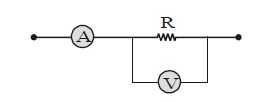
In the circuit shown the readings of ammeter and voltmeter are $4\,\, A$ and $20\,\, V$ respectively. The meters are non ideal, then $R$ is
Medium


Download our appand get started for free
Experience the future of education. Simply download our apps or reach out to us for more information. Let's shape the future of learning together!No signup needed.*
Similar Questions
- 1View SolutionAssertion : An electric bulb becomes dim, when the electric heater in parallel circuit is switched on.
Reason : Dimness decreases after sometime.
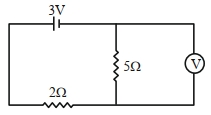
- 2As shown in the figure, the voltmeter reads $2\,V$ across $5\,\Omega$ resistor. The resistance of the voltmeter is $.......\,\Omega$.View Solution
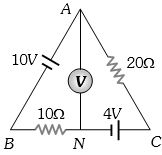
- 3The reading of the ideal voltmeter in the adjoining diagram will be ................. $V$View Solution
- 4View SolutionThe internal resistance of a cell is the resistance of
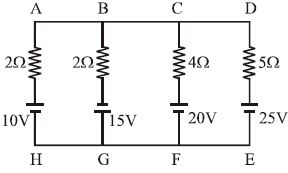
- 5In the given network current through branch $BG$ is almost equal to ............ $A$View Solution
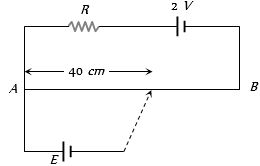
- 6$AB$ is a potentiometer wire of length $100\, cm$ and its resistance is $10 \,\Omega$. It is connected in series with a resistance $R = 40 \,\Omega$ and a battery of $e.m.f.$ $2 \,V$ and negligible internal resistance. If a source of unknown $e.m.f.$ $E$ is balanced by $40\, cm$ length of the potentiometer wire, the value of $E$ is ................. $V$View Solution
- 7If $n, e, \tau$ and $m$ are representing electron density, charge, relaxation time and mass of an electron respectively, then the resistance of a wire of length / and cross-sectional area $A$ is given byView Solution
- 8View SolutionWhich of the following quantities do not change when a resistor connected to a battery is heated due to the current?
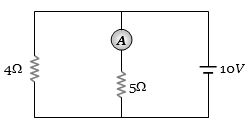
- 9In the circuit, the reading of the ammeter is ................. $A$ (assume internal resistance of the battery be zero)View Solution
- 10An electric kettle takes $4\, A$ current at $220\, V$. How much time will it take to boil $1\, kg$ of water from room temperature $20\,^\circ C$ ? The temperature of boiling water is $100\,^\circ C$ .................. $minutes$View Solution