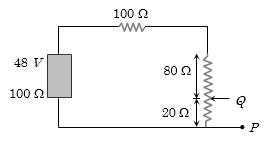
In the circuit, the potential difference across $PQ$ will be nearest to .............. $V$
A$9.6$
B$6.6$
C$4.8$
D$3.2 $
Medium
Download our app for free and get started
D$3.2 $
d Potential difference across $PQ$ i.e. p.d. across the resistance of $20$
$\Omega$, which is $V = i × 20$ and $i = \frac{{48}}{{(100 + 100 + 80 + 20)}} = 0.16\,A$
$V = 0.16 \times 20 = 3.2\,V$.
Download our app
and get started for free
Experience the future of education. Simply download our apps or reach out to us for more information. Let's shape the future of learning together!No signup needed.*
A wire of resistance $R$ is bent to form a square $ABCD$ as shown in the figure. The effective resistance between $E$ and $C$ is ( $E$ is mid-point of arm $CD$ )
A charged particle having drift velocity of $7.5 \times 10^{-4}\, ms ^{-1}$ is an electric field of $3 \times 10^{-10}\, Vm ^{-1}$ has a mobility in $m ^{2} V ^{-1} s ^{-1}$ of
If a $30\, V$, $90\, W$ bulb is to be worked on a $120\, V$ line, a resistance of how many ohms should be connected in series with the bulb ............... $ohm$
A generator has armature resistance of $0 .1\,\Omega $ and develops an induced emf of $120 \,V$ when driven at its rated speed. Its terminal voltage when a current of $50\,A$ is being drawn is ................. $V$
In a Wheatstone bridge, $P = 90\,\Omega $, $Q = 110\,\Omega $ , $R = 40\,\Omega $ and $S = 60\,\Omega $ and a cell of $4\,V\,emf$. Then the potential difference between the diagonal along which a galvanometer is connected is ............. $V$
A galvanometer of resistance, $G,$ is connected in a circuit. Now a resistance $R$ is connected in series of galvanometer. To keep the main current in the circuit unchanged, the resistance to be put in parallel with the series combination of $G$ and $R$ is