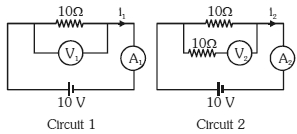
In the circuits shown below, the readings of the voltmeters and the ammeters will be
NEET 2019, Medium
Download our app for free and get started
$10 \Omega$ is in series with ideal voltmeter. Therefore it will not affect the circuit
$\mathrm{I}_{1}=\frac{10}{10}=1 \;\mathrm{A}$
$\mathrm{I}_{2}=\frac{10}{10}=1\; \mathrm{A}$
$V_1=10\;V$
$V_{2}=10\;V$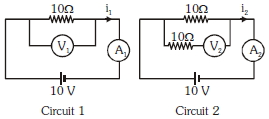

Download our appand get started for free
Experience the future of education. Simply download our apps or reach out to us for more information. Let's shape the future of learning together!No signup needed.*
Similar Questions
- 1The e.m.f. of a cell is $E\, volts$ and internal resistance is $r$ $ohm$. The resistance in external circuit is also $r$ $ohm$. The p.d. across the cell will beView Solution
- 2A cell of internal resistance $3\, ohm$ and $emf$ $10\, volt$ is connected to a uniform wire of length $500 \,cm$ and resistance $3\, ohm$. The potential gradient in the wire is .............. $mV/cm$View Solution
- 3View SolutionBy increasing the temperature, the specific resistance of a conductor and a semiconductor
- 4The effective resistance between the points $A$ and $B$ in the figure is ............. $\Omega$View Solution
- 5Two uniform wires $A$ and $B$ are of the same metal and have equal masses. The radius of wire $A$ is twice that of wire $B$. The total resistance of A and $B$ when connected in parallel isView Solution
- 6$A$ simple circuit contains an ideal battery and a resistance $R$. If a second resistor is placed in parallel with the first,View Solution
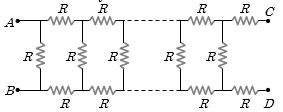
- 7In the figure, the value of resistors to be connected between $C$ and $D$ so that the resistance of the entire circuit between $A$ and $B$ does not change with the number of elementary sets used isView Solution
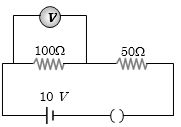
- 8In the given circuit, the voltmeter records $5\, volts$. The resistance of the voltmeter in $ohms$ isView Solution
- 9By a cell a current of $0.9\, A$ flows through $2\, ohm$ resistor and $0.3\,A$ through $7\, ohm$ resistor. The internal resistance of the cell is ............ $\Omega$View Solution
- 10In given figure, the potentiometer wire $AB$ has a resistance of $5$ $\Omega$ and length $10\, m$. The balancing length $AM$ for the $emf$ of $0.4\, V$ is ............... $m$View Solution