MCQ
In the dichromate dianion
  • A
    $4\,Cr - O$ bonds are equivalent
  • $6\,Cr - O$ bonds are equivalent
  • C
    All $Cr - O$ bonds are equivalent
  • D
    All $Cr - O$ bonds are non-equivalent

Answer

Correct option: B.
$6\,Cr - O$ bonds are equivalent
(b) Dichromate dianion has following structure

${\left[ {O \leftarrow \mathop {\mathop {Cr}\limits_ \downarrow ^ \uparrow }\limits_O^O - O - \mathop {\mathop {Cr}\limits_ \downarrow ^ \uparrow }\limits_O^O \to O} \right]^{2 - }}$

$6,$ $Cr - O$ bonds are equivalent.

Need a full question paper?

Generate a complete, print-ready paper with questions like this in minutes — across 16+ boards, with answer keys.

Start Generating Free

Similar questions

Which of the following triatomic molecules does not exist ?
Which of the following compound has trans as well as $Z$ configuration around double bond
Five valence electrons of $P^{15}$ are labelled as $\mathop {\boxed{AB}}\limits_{3s} \,\mathop {\boxed{X|Y|Z}}\limits_{3p} $ If the spin quantum numbers of $B$ and $Z$ is $ + \frac{1}{2}$ , the group of electron with three of the quantum number $(n, l, m)$ same are
Fastest rate of reaction will be when $R$ is
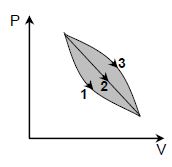
A given mass of gas expands from the state $A$ to the state $B$ by three paths $1, 2$ and $3$ as shown in the figure. If $w_1, w_2$ and $w_3$ respectively be the work done by the gas along three paths then
Arrange the following in order of their leaving group tendency?

$(I)\,\,B{r^ - }{\mkern 1mu} {\mkern 1mu} {\mkern 1mu} {\mkern 1mu} $       $(II)\,\,\begin{array}{*{20}{c}}
  {{\mkern 1mu} {\mkern 1mu} {\mkern 1mu} {\mkern 1mu} {\mkern 1mu} O{\mkern 1mu} } \\ 
  {{\mkern 1mu} {\mkern 1mu} {\mkern 1mu} {\mkern 1mu} ||} \\ 
  {{H_3}C - C - {O^ - }} 
\end{array}$    $(III)\,\,C{H_3}C{H_2}{O^ - }$    $(IV)\,\,Ph - {O^ - }$

In which compound, oxidation state of nitrogen is $1$
The boiling points at atmospheric pressure of $HF, H_2S, NH_3$ can be  arranged in the following order
Above conversion can be acheived by
In a reaction, the concentration of reactant is increased two times and three times then the increases in rate of reaction were four times and nine times respectively, order of reaction is