MCQ
In the electrolytic cell, flow of electrons is from:
  • A
    Cathode to anode in solution.
  • B
    Cathode to anode through external supply.
  • C
    Cathode to anode through internal supply.
  • D
    Anode to cathode through internal supply.

Answer

  1. Cathode to anode through internal supply.

Explanation:

Hint: Electrons flow from the negative to a positive end.

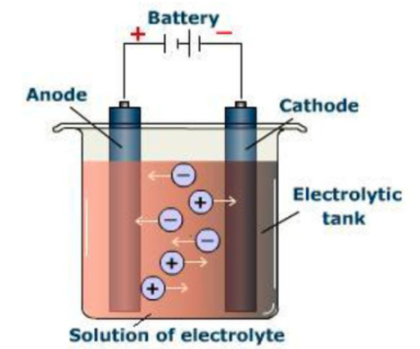
Step 1: A cell in which Electrical energy is used to cause a non-spontaneous oxidation and reduction reaction is called an Electrolytic cell.
The electrolytic cell requires an energy input to proceed.

Step 2:  Electrolytic cell contains three parts Cathode, Anode, and electrolyte.

Positive electrode is called anode.

Negative electrode is called Cathode.

An electrolyte is a  substance in an aqueous or molten form that dissociates into ions and conducts electricity.

In a electrolytic cell, electrons are transferred from cathode to anode through internal supply.
Need a full question paper?

Generate a complete, print-ready paper with questions like this in minutes — across 16+ boards, with answer keys.
Start Generating Free

Similar questions

Ethyl bromide reacts with silver nitrite to form
Which of the following gives the most stable carbocation by dehydration?
The dissociation constant of acetic acid is $1.6 \times 10^{-5}$ and $\Lambda _{C{H_3}COOH}^o\,370.6\, \times \,{10^{ - 4}}\,{\text{mho }}{{\text{m}}^2}{\text{ mo}}{{\text{l}}^{ - 1}}$ The specific conductance of $0.01\,\, molar$ acetic acid solution will be approx
The incorrect statement regarding enzymes is :
The molar conductivities $\Lambda _{NaOH}^o$ and $\Lambda _{HCl}^o$ at infinite dilution in water at $25^o C$ are $91.0$ and $426.2\, S \,cm^2/mol$ respectively. To calculate $\Lambda _{HOAc}^o,$ the additional value required is
The decomposition reaction $2 N _2 O _5( g ) \xrightarrow{\Delta} 2 N _2 O _4( g )+ O _2( g )$ is started in a closed cylinder under isothermal isochoric condition at an initial pressure of $1 atm$. After $Y \times 10^3 s$, the pressure inside the cylinder is found to be $1.45 atm$. If the rate constant of the reaction is $5 \times 10^{-4} s ^{-1}$, assuming ideal gas behavior, the value of $Y$ is. . . . . . . .
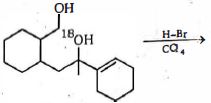
Major product obtained in the reaction is
$V. P.$ of pure $A$                                                $p^o_A= 100\,mmHg$

$V. P.$ of pure $B$                                                $p^o_B = 150\,mmHg$

A solution containing $2\,moles$ $A$ and $3\,moles$ $B$ will have total vapour pressure, approximately, on condensation ......... $mm$.

The elevation in boiling point for one molal solution of a solute in a solvent is called
The complex used as an anticancer agent is