MCQ
In the equilibrium  $ HClO‌‌_4+H‌‌_2O $ $\rightleftharpoons$ $ H_2O^+$+$ClO_4^ - $
  • A
    $HCl{O_4}$ is the conjugate acid of ${H_2}O$
  • B
    ${H_2}O$ is the conjugate acid of ${H_3}{O^ + }$
  • C
    ${H_3}{O^ + }$is the conjugate base of ${H_2}O$
  • $ClO_4^ - $ is the conjugate base of $HCl{O_4}$

Answer

Correct option: D.
$ClO_4^ - $ is the conjugate base of $HCl{O_4}$
(d) $HCl{O_4}$ is a acid and their conjugate base is $ClO_4^ - $.

Need a full question paper?

Generate a complete, print-ready paper with questions like this in minutes — across 16+ boards, with answer keys.

Start Generating Free

Similar questions

Which of the following is least basic?
In most cases, for a rise of $10\,K$ temperature the rate constant is doubled to tripled. This is due to the reason that
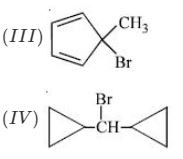
Arrange the following compounds in decreasing order of their reactivity for hydrolysis reaction

$(I)$ $C_6H_5-CH-Br$

$(II)$ $\begin{array}{*{20}{c}}
  {{C_6}{H_5} - CH - {C_2}{H_5}} \\ 
  {|\,\,\,} \\ 
  {Br} 
\end{array}$

The element the usually does $NOT$ show variable oxidation states is
How many litres of $C{O_2}$ at $STP $ will be formed when $100\,ml$ of $0.1\,M\,{H_2}S{O_4}$ reacts with excess of $N{a_2}S{O_3}$
Electrophilic substitution of with bromine gives
For the following reactions the major products are shown 

${H_2}C = CH - CH = C{H_2}\xrightarrow[{0{\,^o}C}]{{HBr}}$ $\begin{array}{*{20}{c}}
  {{H_2}C = CH - CH - C{H_3}} \\ 
  {\,\,\,\,\,\,\,\,\,\,\,|} \\ 
  {\,\,\,\,\,\,\,\,\,\,\,\,\,\,\,\,\,\,\,Br\,\,\,\,\,\,} 
\end{array}\xrightarrow{{ + 25{\,^o}C}}$ $\begin{array}{*{20}{c}}
  {C{H_2}CH = CHC{H_3}} \\ 
  {|\,\,\,\,\,\,\,\,\,\,\,\,\,\,\,\,\,\,\,\,\,\,\,\,\,\,\,\,\,\,\,\,\,\,\,\,\,\,\,} \\ 
  {Br\,\,\,\,\,\,\,\,\,\,\,\,\,\,\,\,\,\,\,\,\,\,\,\,\,\,\,\,\,\,\,\,\,\,\,\,} 
\end{array}$

These provide an example of  $......1......$ control at low temperature and $......2......$  control at higher temperature
Which one of the following species does not represent cationic species of vanadium formed in aqueous solution
What is the work function of the metal if the light of wavelength $4000\, \mathop A\limits^o $ generates photoelectrons of velocity $6\times10^5\, ms^{-1}$ from it? ............. $\mathrm{eV}$ (Mass of electron $= 9\times10^{-31}\, kg$ Velocity of light $= 3\times10^8\, ms^{-1}$ Planck’s constant $= 6.626\times10^{-34}\, Js$ Charge of electron $= 1.6\times10^{-19}\, J\,eV^{-1}$)
What would be the concentration of ${H_2}S{O_4}$ necessary to precipitate $BaS{O_4}$ from a solution of $0.01\,M\,B{a^{2 + }}$ions ($K_sp=$ $1.0 \times {10^{ - 9}}$ )