MCQ
In the esterification reaction of alcohols
- ✓$O{H^ - }$ is replaced by $C{H_3}CO{O^-}$ group
- B$O{H^ - }$ is replaced by chlorine
- C${H^ - }$ is replaced by sodium metal
- D$O{H^ - }$is replaced by ${C_2}{H_5}OH$
Generate a complete, print-ready paper with questions like this in minutes — across 16+ boards, with answer keys.
$2 Fe _{( s )}+ O _{2( g )}+4 H _{( aq )}^{+} \rightarrow 2 Fe _{( aq )}^{2^{+}}+2 H _2 O ( l ) \quad E ^{\circ}=1.67 V$, At $\left[ Fe ^{2+}\right]=10^{-3} M , P \left( O _2\right)=0.1$ atm and $pH =3$, the cell potential at $25^{\circ} C$ is
Assertion $(A)$ : Haloalkanes react with $\mathrm{KCN}$ to form alkyl cyanides as a main product while with $\mathrm{AgCN}$ form isocyanide as the main product.
Reason $(R)$ : $\mathrm{KCN}$ and $\mathrm{AgCN}$ both are highly ionic compounds.
In the light of the above statement, choose the most appropriate answer from the options given below:
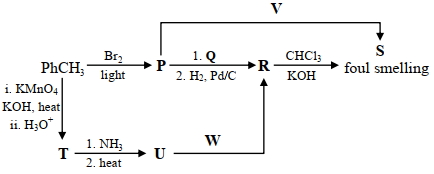
$(A)$ $Q = KNO _2, W = LiAlH _4$
$(B)$ $R =$ benzenamine, $V = KCN$
$(C)$ $Q = AgNO _2, R =$ phenylmethanamine
$(D)$ $W = LiAlH _4, V = AgCN$