MCQ
In the expansion of $(1+x)^n \cdot(1+y)^n \cdot(1+z)^n$ the sum of the coefficients of the terms of degree $r$ is:
 
  • A
    $\left({ }^n \mathrm{C}_r\right)^3$
  • ${ }^{3 n} \mathrm{C}_{\mathrm{r}}$
  • C
    ${ }^{3 \times n} C_r$
  • D
    ${ }^n \mathrm{C}_{3 \mathrm{r}}$

Answer

Correct option: B.
${ }^{3 n} \mathrm{C}_{\mathrm{r}}$
  1. ${ }^{3 n} \mathrm{C}_{\mathrm{r}}$
Solution:
The given expression contains 3n factors
Using combination to choose r brackets out of 3n brackets for a term of degree r, we get
${ }^{3 n} \mathrm{C}_{\mathrm{r}}$

Need a full question paper?

Generate a complete, print-ready paper with questions like this in minutes — across 16+ boards, with answer keys.

Start Generating Free

Similar questions

Amy and Adam are making boxes of truffles to give out as wedding favors. They have an unlimited supply of 5 different types of truffles. If each box holds 2 truffles of different types, how many different boxes can they make?
If $(1+\text{i})(1+2\text{i})(1+3\text{i})...(1+\text{ni})=\text{a}+\text{ib},$ then 2.5.10.17...$(1+\text{n}^2)=$
From the origin, chords are drawn to the circle ${(x - 1)^2} + {y^2} = 1$. The locus of mid points of these chords is a
If $|8 + z| + |z - 8| = 16$ where $z$ is a complex number, then the point $z$ will lie on
The number of integers $q , 1 \leq q \leq 2021$, such that $\sqrt{ q }$ is rational, and $\frac{1}{ q }$ has a terminating decimal expansion, is
Two dice are thrown:
P is the event that the sum of the scores on the uppermost faces is a multiple of 6.
Q is the event that the sum of the scores on the uppermost faces is at least 10.
R is the event that same scores on both dice. Which of the following pairs is mutually exclusive?
The number of nine digit numbers that can be formed with different digits is:
A point $P$ moves on the line $2x -3y + 4 = 0$. If $Q(1, 4)$ and $R(3, -2)$ are fixed points, then the locus of the centroid of $\Delta PQR$ is a line
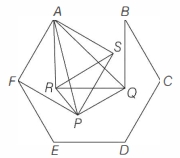
In the figure given below, $A B C D E F$ is a regular hexagon of side length $1$, $A F P S$ and $A B Q R$ are squares. Then, the ratio $\operatorname{ar}(A P Q) \operatorname{lar}(S R P)$ equals
If ${z_1}$ and ${z_2}$ are two complex numbers satisfying the equation $\left| \frac{z_1 +z_2}{z_1 - z_2} \right|=1$, then $\frac{{{z_1}}}{{{z_2}}}$ is a number which is