Question
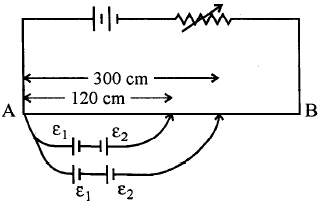
In the figure a long uniform potentiometer wireABis having a constant potential gradient along its length. The null points for the two primary cells of emfs $\varepsilon_{1}$ and $\varepsilon_{2}$
connected in the manner shown are obtained at a distance of 120 cm and 300 cm from the end A. Find (i) $\varepsilon_{1}$/$\varepsilon_{2}$and (ii) position of null point for the cell $\varepsilon_{1}$. How is the sensitivity of a potentiometer increased?
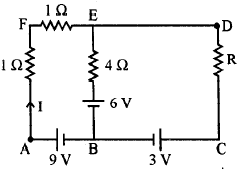
Using Kirchoffs rules determine the value of unknown resistance R in the circuit so that no current flows through 4 $\Omega$ resistance.Also find the potential difference between A and D.

Answer

  1. $\varepsilon_{1} + \varepsilon_{2}$ = 300k (k is potential gradient in volt/cm)

$\varepsilon_{1} - \varepsilon_{2} = 120 \text{k}$

$\Rightarrow\frac{\varepsilon_{1}}{\varepsilon_{2}} = 7 / 3$

  1. $\varepsilon_{1} + \varepsilon_{2} = 300\text{k}$

$\therefore\varepsilon_{1} + \frac{3}{7}\varepsilon_{1} = 300 \text{k}$

$\Rightarrow\varepsilon_{1} = 210 \text{k}$

Therefore, balancing length for cell $\varepsilon_{1}$ is 210cm.

  1. By decreasing potential gradient.

[Or through Increasing length, reducing potential drop across wire, increasing resistance put in series with the main cell etc.]

Alternate Answer

Applying Kirchhoff's Voltage rule

for loop ABEFA

-9 + 6 + 4 x 0 +2 I = 0

2 I – 3 = 0

$\text{I} =\frac{3}{2}\text{A} = 1.5\text{A}$

For loop BCDEB

3 + I R + 4 x 0– 6 = 0

$\therefore\text{IR} = 3 $

Substituting the value of current I,

$\frac{3}{2}\times\text{R} = 3 $

$\therefore\text{R} = 2\Omega$

Potential difference between A & D

Through path ABCD

+9V – 3V – IR = VAD

$ + 9 - 3 - \frac{3}{2}\times2 = \text{V}_{AD}$

$\Rightarrow\text{V}_{AD} = 3\text{V}$

Alternate Answer

through path AFD

$\frac{3}{2}\times2 =\text{V}_{AD}$

$\Rightarrow\text{V}_{AD} = 3 \text{V}.$

Need a full question paper?

Generate a complete, print-ready paper with questions like this in minutes — across 16+ boards, with answer keys.

Start Generating Free

Similar questions

A free atom of iron emits $\text{K}_\alpha$ X-rays of energy 6.4keV. Calculate the recoil kinetic energy of the atom. Mass of an iron atom = 9.3 × 10⁻²⁶kg.
A tank is filled with water to a height of 12.5 cm. The apparent depth of a needle lying at the bottom of the tank is measured by a microscope to be 9.4 cm. What is the refractive index of water? If water is replaced by a liquid of refractive index 1.63 up to the same height, by what distance would the microscope have to be moved to focus on the needle again?
A short magnet is moved along the axis of a conducting loop. Show that the loop repels the magnet if the magnet is approaching the loop and attracts the magnet if it is going away from the loop.
An $\alpha$-particle and a proton moving with the same speed enter the same magnetic field region at right angles to the direction of the field. Show the trajectories followed by the two particles in the region of the magnetic field. Find the ratio of the radii of the circular paths which the two particles may describe.

Write Einstein’s photoelectric equation and point out any two characteristic properties of photons on which this equation is based.
Briefly, explain the three observed features which can be explained by this equation.
A ball is dropped from a height. If it takes 0.200s to cross the last 6.00m before hitting the ground, find the height from which it was dropped. Take g = 10m/s2.
Show that the wavelength of electro-magnetic radiation is equal to the de-Broglie wavelength of its quantum (photon).
A charge of $20\mu\text{C}$ is placed on the positive plate of an isolated parallel-plate capacitor of capacitance $10\mu\text{F}.$ Calculate the potential difference developed between the plates.
Draw a labelled ray diagram of an astronomical telescope in the near point adjustment position.
A giant refracting telescope at an observatory has an objective lens of focal length 15m and an eyepiece of focal length 1.0cm. If this telescope is used to view the Moon, find the diameter of the image of the Moon formed by the objective lens. The diameter of the Moon is 3.48 × 10⁶m, and the radius of lunar orbit is 3.8 × 10⁸m.
Write the order of frequency range and one use of each of the following electromagnetic radiations:
  1. Microwaves.
  2. Ultra-violet rays.
  3. Gamma rays.