MCQ
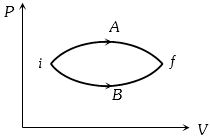
In the figure given two processes $A$ and $B$ are shown by which a thermo-dynamical system goes from initial to final state $F.$ If $\Delta {Q_A}$ and $\Delta {Q_B}$ are respectively the heats supplied to the systems then
  • A
    $\Delta {Q_A} = \Delta {Q_B}$
  • B
    $\Delta {Q_A} \ge \Delta {Q_B}$
  • C
    $\Delta {Q_A} < \Delta {Q_B}$
  • $\Delta {Q_A} > \Delta {Q_B}$

Answer

Correct option: D.
$\Delta {Q_A} > \Delta {Q_B}$
d
(d) $\Delta Q = \Delta U + \Delta W;$       $\Delta  U$ does not depend upon path.

 $\because  \Delta {W_A} > \Delta {W_B}$ ==> $\Delta {Q_A} > \Delta {Q_B}$

Need a full question paper?

Generate a complete, print-ready paper with questions like this in minutes — across 16+ boards, with answer keys.

Start Generating Free

Similar questions

A block of ice floats on a liquid of density $1.2$ in a beaker then level of liquid when ice completely melt
Equal volumes of two gases at the same temperature and pressure have the same:
A body of area $1\, cm^2$ is heated to a temperature $1000\, K$. The amount of energy radiated by the body in $1\, second$ is .......... $Joule$ (Stefan's constant $\sigma  = 5.67 \times 10^{-8}\, W\, m^{-2}K^{-4}$)
body moves with constant angular velocity on a circle. Magnitude of angular acceleration
A metal wire having Poisson's ratio $1 / 4$ and Young's modulus $8 \times 10^{10} \,N / m ^2$ is stretched by a force, which produces a lateral strain of $0.02 \%$ in it. The elastic potential energy stored per unit volume in wire is [in $\left.J / m ^3\right]$
A man moves in an open field such that after moving $10 \,m$ on a straight line, he makes a sharp turn of $60^{\circ}$ to his left. The total displacement just at the start of $8^{\text {th }}$ turn is equal to ........$m$
A particle starts rotating from rest. Its angular displacement is expressed by the following equation $\theta  = 0.025{t^2} - 0.1t$ where $\theta $ is in radian and $t $ is in seconds. The angular acceleration of the particle is 
Two beads connected by massless inextensible string are placed over the fixed ring as shown in figure. Mass of each bead is $m$ , and there is no friction between $B$ and ring. Find minimum value of coefficient of friction between $A$ and ring so that system remains in equilibrium. ( $C \to $center of ring, $AC$ line is vertical)
When $M_1$ gram of ice at $-10\,^oC$ (specific heat $= 0.5\, cal\, g^{-1}\,^oC^{-1}$) is added to $M_2$ gram of water at $50\,^oC$, finally no ice is left and the water is at $0\,^oC$. The value of latent heat of ice, in $cal\, g^{-1}$ is
A ring and a disc are initially at rest, side by side, at the top of an inclined plane which makes an angle $60^{\circ}$ with the horizontal. They start to roll without slipping at the same instant of time along the shortest path. If the time difference between their reaching the ground is $(2-\sqrt{3}) / \sqrt{10} \mathrm{~s}$, then the height of the top of the inclined plane, in metres, is. . . . . . Take $g=10 \mathrm{~m} \mathrm{~s}^{-2}$.