Question
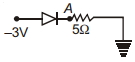
In the figure given, voltage of point $A$ is ............ $V$
Answer

(a)

The diode is reverse biased.

Since no current flows in circuit no voltage drop occurs in resistor.

Need a full question paper?

Generate a complete, print-ready paper with questions like this in minutes — across 16+ boards, with answer keys.
Start Generating Free

Similar questions

A Galileo telescope has an objective of focal length $100\,cm$ and magnifying power $50$. The distance between the two lenses in normal adjustment will be......$cm$
The equation of progressive wave is $y = 0.2\sin 2\pi \left[ {\frac{t}{{0.01}} - \frac{x}{{0.3}}} \right]$, where $x$ and $y$ are in metre and $t$ is in second. The velocity of propagation of the wave is .... $m/s$
A charge $q$ $coulomb$ moves in a circle at $n$ revolutions per second and the radius of the circle is $r$ $metre$. Then magnetic field at the centre of the circle is
A gamma ray photon creates an electron- positron pair. If the rest mass energy of an electron is $0.5\, MeV$ and the total $K.E.$ of the electron- positron pair is $0.78\, MeV$, then the energy of the gamma ray photon must be.......$MeV$
In a compound microscope, if the objective produces an image $I_o$ and the eye piece produces an image $I_e$, then
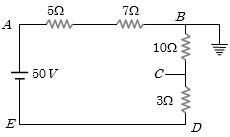
In the circuit shown, the point ‘$B$’ is earthed. The potential at the point ‘$A$’ is ............. $V$
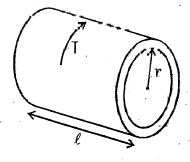
A hollow cylinder has length $l$ , radius $r$ , and thickness $d$ , where $l >> r >> d$ , and is made of a material with resistivity $\rho $ . A timevarying current $I$ flows through the cylinder in the tangential direction. Assume the current is always uniformly distributed along the length of the cylinder. The cylinder is fixed so that it cannot move; assume that there are no externally generated magnetic fields during the time considered for the problems below. Assume current at $t = 0$ to be $I_0$. What is current  $I(t)$ for $t > 0$
The region between $y = 0$ and $y = d$ contains a magnetic field $\vec B = B\hat z$ A particle of mass $m$ and charge $q$ enters the region with a velocity $\vec v = v\hat i$. If $d = \frac{{mv}}{{2qB}}$ , the acceleration of the charged particle at the point of its emergence at the other side is
Which of the following equations is dimensionally incorrect?

Where $t=$ time, $h=$ height, $s=$ surface tension, $\theta=$ angle, $\rho=$ density, $a, r=$ radius, $g=$ acceleration due to gravity, ${v}=$ volume, ${p}=$ pressure, ${W}=$ work done, $\Gamma=$ torque, $\varepsilon=$ permittivity, ${E}=$ electric field, ${J}=$ current density, ${L}=$ length.

The power of two convex lenses $A$ and $B$ are $8$ diopters and $4$ diopters respectively. If they are to be used as a simple microscope, the magnification of