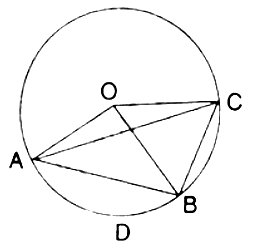
In the figure, $O$ is the centre of the circle and the length of arc $AB$ is twice the length of arc $BC.$ If angle $AOB = 108^\circ$ find $: \angle ADB.$
Exercise 17 (B) | Q 8.2 | Page 265
Download our app for free and get started
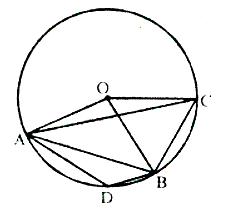
Again, Arc $AB$ subtends $\angle AOB$ at the centre and
$\angle ACB$ at the remaining part of the circle.
$\angle ACB =\frac{1}{2} \angle AOB$
$=\frac{1}{2} \times 108^{\circ}$
$=54$
In cyclic quadrilateral $ADBC$
$\angle ADB + \angle ACB =180^\circ$ (sum of opposite angles)
$\Rightarrow \angle ADB + 54^\circ = 180^\circ$
$\Rightarrow \angle ADB = 180^\circ - 54^\circ$
$\Rightarrow \angle ADB = 126^\circ$

Download our appand get started for free
Experience the future of education. Simply download our apps or reach out to us for more information. Let's shape the future of learning together!No signup needed.*
Similar Questions
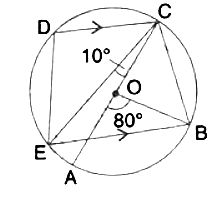
- 1In the given figure, AC is the diameter of circle, centre $\mathrm{O} . \mathrm{CD}$ and BE are parallel. Angle $\mathrm{AOB}=80^{\circ}$ and angle $\mathrm{ACE}=$ $10^{\circ}$. Calculate : Angle BCDView Solution
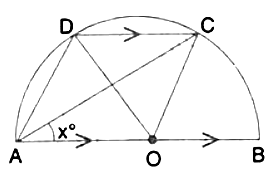
- 2In the given figure, $A O B$ is a diameter and $D C$ is parallel to $A B$. If $\angle C A B=x^0$; find (in terms of $x$ ) the values of: $\angle$ ADC.View Solution
- 3View SolutionIn the given figure, M is the centre of the circle. Chords AB and CD are perpendicular to each other.
If ∠MAD = x and ∠BAC = y : express ∠AMD in terms of x.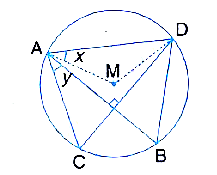
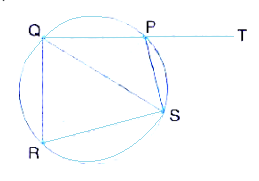
- 4View SolutionIn the given figure, SP is bisector of ∠RPT and PQRS is a cyclic quadrilateral. Prove that SQ = SR .
- 5View SolutionIn the figure, given alongside, AB ∥ CD and O is the centre of the circle. If ∠ADC = 25°; find
the angle AEB give reasons in support of your answer.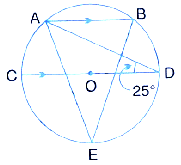
- 6View SolutionIn a regular pentagon ABCDE, Inscribed in a circle; find ratio between angle EDA and angle ADC.
- 7View SolutionIn the figure, ∠DBC = 58°. BD is a diameter of the circle. Calculate : ∠BDC
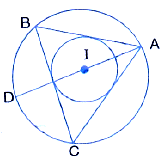
- 8View SolutionIf I is the incentre of triangle ABC and AI when produced meets the circumcircle of triangle ABC in point D. If ∠BAC = 66° and ∠ABC = 80°. Calculate : ∠DBC
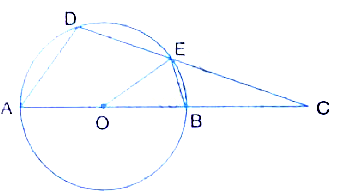
- 9View SolutionIn the figure, O is the centre of the circle, ∠AOE = 150°, ∠DAO = 51°. Calculate the sizes of the angles CEB and OCE.
- 10In the given figure, $A O B$ is a diameter and $D C$ is parallel to $A B$. If $\angle C A B=x^{\circ}$; find (in terms of $x$ ) the values of: $\angle$ DOC.View Solution