MCQ
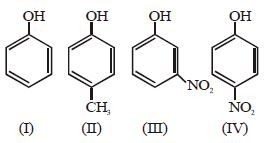
In the following compounds

The order of acidity is
  • A
    $III > IV > I > II$
  • B
    $I > IV > III > II$
  • C
    $II > I > III > IV$
  • $IV > III > I > II$

Answer

Correct option: D.
$IV > III > I > II$
d

Need a full question paper?

Generate a complete, print-ready paper with questions like this in minutes — across 16+ boards, with answer keys.

Start Generating Free

Similar questions

Which one of the following polymer is prepared by condensation polymerization?
A voltaic cell converts:
For a complex reaction $A\,\xrightarrow{K}$ products $Ea_1=180\,KJ/mol$ ,   $Ea_2 = 80\,KJ/mol$,    $Ea_3 = 50\,KJ/mol$ overall rate constant $K$ is related to individual rate constant by the equation $K\, = \,\,{\left( {\frac{{{K_1}.{K_2}}}{{{K_3}}}} \right)^{2/3}}$. Activation energy $(KJ/mol)$ for the overall reaction is
$\begin{matrix}
   Ph-CH-C{{H}_{2}}-C{{H}_{2}}\xrightarrow[\Delta ]{Zn-Cu}  \\
   \,\,\,\,\,|\,\,\,\,\,\,\,\,\,\,\,\,\,\,\,\,\,\,\,\,\,\,\,\,\,\,\,\,\,\,\,\,\,\,\,|\,\,\,\,\,\,\,\,\,\,\,\,\,\,\,\,  \\
   \,\,\,\,\,Br\,\,\,\,\,\,\,\,\,\,\,\,\,\,\,\,\,\,\,\,\,\,\,\,\,\,\,\,\,Br\,\,\,\,\,\,\,\,\,\,\,\,\,\,  \\
\end{matrix}$ Product

Product of the above reaction is

$\,$
$\begin{array}{*{20}{c}}
  {O\,\,\,\,\,\,\,\,\,\,\,\,\,\,\,\,\,\,\,\,\,\,\,\,\,\,\,\,\,\,\,\,\,\,\,\,\,\,\,\,\,\,\,\,\,\,\,\,\,\,\,\,\,\,\,\,\,\,\,} \\ 
  {||\,\,\,\,\,\,\,\,\,\,\,\,\,\,\,\,\,\,\,\,\,\,\,\,\,\,\,\,\,\,\,\,\,\,\,\,\,\,\,\,\,\,\,\,\,\,\,\,\,\,\,\,\,\,\,\,\,\,\,\,\,} \\ 
  {Ph - C - OH\xrightarrow{{SOC{l_2}}}(A)\xrightarrow[{Pd - BaS{O_4}}]{{{H_2}}}(B)} 
\end{array}$

Product $(B)$ is

Given that $E_{{O_2}/{H_2}O}^o =  + 1.23\,V$; $E_{{S_2}O_8^{2 - }/SO_4^{2 - }}^o =   2.05\,V$; $E_{B{r_2}/B{r^ - }}^o = +1.09\,V$; $E_{A{u^{3 + }}/Au}^o = 1.4\,V$. The strongest oxidizing agent is
Choose the incorrect option
$\mathrm{H}_2 \mathrm{~S}$ ($5$ moles) reacts completely with acidified aqueous potassium permanganate solution. In this reaction, the number of moles of water produced is $x$, and the number of moles of electrons involved is $y$. The value of $(x+y)$ is. . . . . .
The half-life period of a first order reaction is $15\,minutes$. The amount of substance left after one hour will be