MCQ
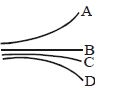
In the following diagram, which particle has highest $e/m$ value?
  • A
    $A$
  • B
    $B$
  • C
    $C$
  • $D$

Answer

Correct option: D.
$D$
d
The deflection of a particle along $y-$axis is electricfield is given by $y=\frac{E e x^{2}}{2 m v^{2}}$

$\Rightarrow \mathrm{y} \propto \frac{\mathrm{e}}{\mathrm{m}}$ for all other values to be constant. since $y$ is maximum for $D$, hence it has highest $e/m $ ratio.

Need a full question paper?

Generate a complete, print-ready paper with questions like this in minutes — across 16+ boards, with answer keys.
Start Generating Free

Similar questions

A current of $2\, mA$ was passed through an unknown resistor which dissipated a power of $4.4\, W$. Dissipated power when an ideal power supply of $11\, V$ is connected across it is
In the figure, an air lens of radii of curvature 10 cm ($\mathrm{R}_1=\mathrm{R}_2=10 \mathrm{~cm}$) is cut in a cylinder of glass (μ = 1.5). The focal length and the nature of the lens is
A $10\,m$ long horizontal wire extends from North East to South West. It is falling with a speed of $5.0\,ms^{-1},$ at right angles to the horizontal component of the earth’s magnetic field, of $0.3\times 10^{-4}\,Wb/m^2$. The value of the induced $emf$ in wire is 
A potentiometer is an accurate and versatile device to make electrical measurements of $EMF$ because the method involves 
Choose the correct answer from the alternatives given. The amplitude of an electromagnetic wave in vaccum is doubled with no other changes made to the wave. As a result of this doubling of the amplitude, which of the following statement is correct?
A star has $10^{40}$ deuterons. It produces energy via the process,

$_1{H^2}{ + _1}{H^2}{ \to _1}{H^3} + P$  and

$_1{H^2}{ + _1}{H^3}{ \to _2}{He^4} + n$ 

If the averages power radiated by the star is $10^{16}\ W, $ the deuteron supply of the star is exhausted in a time of the order of :

Given: mass of $_1H{^2}$  = $2.041\ amu$ 

            mass of $_2H{e^4}$ = $4.001\ amu$

            mass of $proton = 1.007\ amu$

            mass of $neutron = 1.008\ amu$        

$_{90}^{232} $ Than isotope of thorium decays in ten stages emitting six a-particles and four b-particles in all. The end product of the decay is
When photons of energy $hf$ fall on an aluminium plate (of work function $ E_0$), photoelectrons of maximum kinetic energy $K$ are ejected. If the frequency of radiation is doubled, the maximum kinetic energy of the ejected photoelectrons will be 
Rest mass energy of an electron is 0.51 MeV. If this electron is moving with a velocity 0.8 c (where c is velocity of light in vacuum), then kinetic energy of the electron should be.
de-Broglie wavelength of an electron in the nth Bohr orbit is $\lambda_n$ and the angular momentum is $J_n$, then: