Question
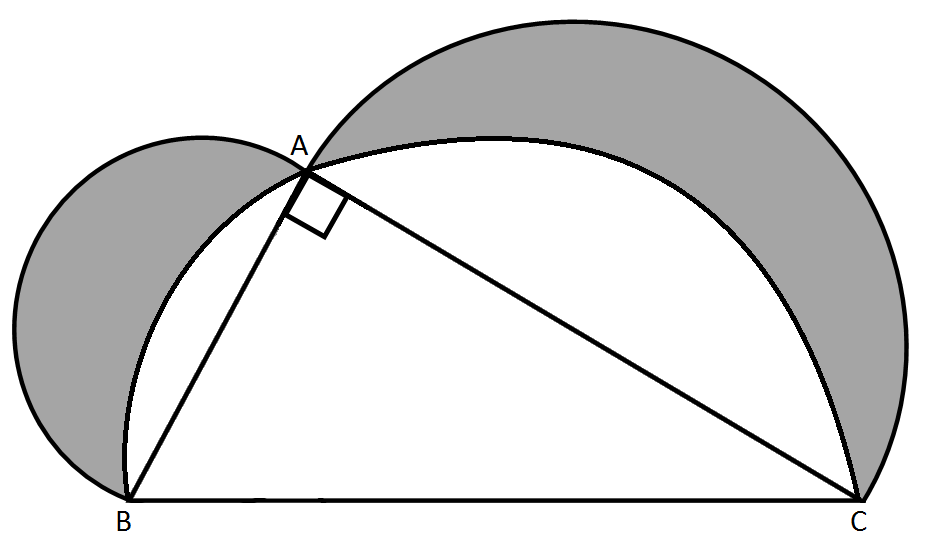
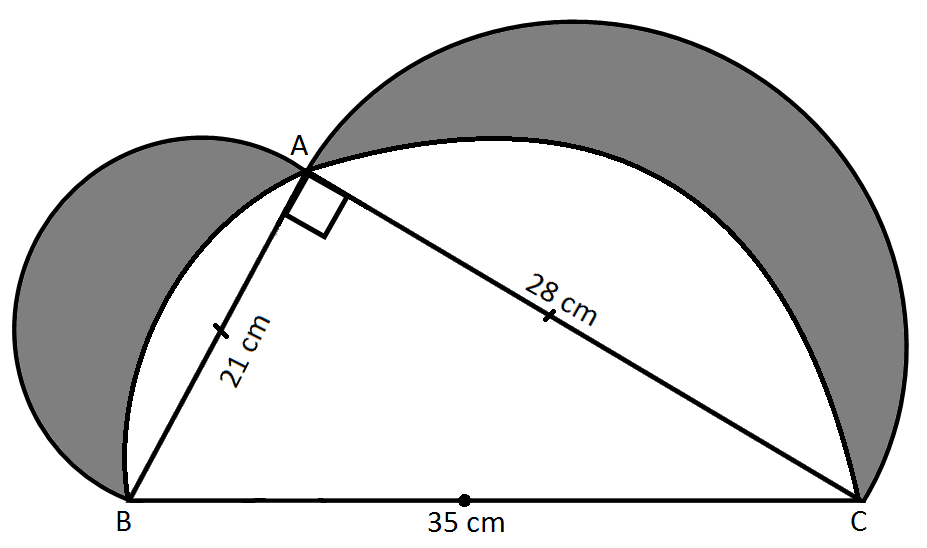
In the following figure, ABC is a right angled triangle in which $\angle\text{A}=90^\circ,$ $AB = 21\ cm$ and $AC = 28\ cm$. Semi-circles are described on AB, BC and AC as diameters. Find the area of the shaded region.
Answer

In the figure, ABC is a right triangle in a semicircle $\angle\text{A}=90^\circ,$ $AB = 21\ cm$ and $AC = 28\ cm$

Semicircles are drawn on BC and AC as diameters
In right $\triangle\text{ABC}$
$BC^2 = AB^2 + AC^2$​​​​​​​ (Pythagoras Theorem)
$= 21^2 + 28^2$
$= 441 + 784 = 1225 = (35)^2$​​​​​​​
$\therefore$ $BC = 35\ cm$
Now radius of bigger semicircle (R) $=\frac{35}{2}\text{cm},$
of semicircle at $\text{AB}=\frac{21}{2}\text{cm}$ and of semicircle on $\text{AC}=\frac{28}{2}\text{cm}=14\text{cm}$
Now area of shaded portion
= Area of semicircle on AB as diameter + area of semicircle on AC as diameter + area of $\triangle\text{ABC}$ - area of
semicircle on BC as diameter
$=\frac{1}{2}\pi\Big(\frac{21}{2}\Big)^2+\frac{1}{2}\cdot\pi\Big(\frac{28}{2}\Big)^2+\frac{1}{2}\text{AB}\times\text{AC}-\frac{1}{2}\pi\Big(\frac{35}{2}\Big)^2$
$=\frac{\pi}{2}\bigg[\Big(\frac{21}{2}\Big)^2+\Big(\frac{28}{2}\Big)^2-\Big(\frac{35}{2}\Big)^2\bigg]+\frac{1}{2}\times21\times28$
$=\frac{\pi}{2}\Big[\frac{441}{4}+196-\frac{1225}{4}\Big]+294$
$=\frac{\pi}{2}\big[441+784-1225\big]+294$
$=\frac{\pi}{2}\times\big[1225-1225\big]+294$
$=\frac{\pi}{2}\times0+294=294\text{cm}^2$

Need a full question paper?

Generate a complete, print-ready paper with questions like this in minutes — across 16+ boards, with answer keys.

Start Generating Free

Similar questions

Suyash scored 10 marks more in second test than that in the first. 5 times the score of the second test is the same as square of the score in the first test. Find his score in the first test.
In the following, determine whether the given values are solution of the given equation or not:
$\text{x}^2-\sqrt{2}\text{x}-4=0,$ $\text{x}=-\sqrt{2},$ $\text{x}=-2\sqrt{2}$
Find the distance between of the following points from the origin:
B(-5, 5)
A cubical block of side $10\ cm$ is surmounted by a hemisphere. What is the largest diameter that the hemisphere can have?
Find the cost of painting the total surface area of the solid so formed, at the rate of $Rs\ 5\ per\ 100\ sq\ cm$. $\Big[\text{Use }\pi=3.14\Big]$
The mean of the following frequency distribution is 50. Find the value of f :
Class
interval
10 - 2020 - 4040 - 6060 - 8080 - 100
Frequency14f322419
Find quadratic equation such that its roots are square of sum of the roots and square of difference of the roots of equation
$2 x^2+2(p+q) x+p^2+q^2=0$
From a solid cylinder of height $14\ cm$ and base diameter $7\cm,$ two equal conical holes each of radius 2.1cm and height 4cm are cut: off. Find the volume of the remaining solid.
Verify that $5, -2$ and $\frac{1}3{}$ are the zeros of the cubic polynomial $p(x) = 3x^3 - 10x^2 - 27x + 10$ and verify the relation between its zeros and coefficients.
Determine, by drawing graphs, whether the following system of linear equations has a unique solution or not:
2y = 4x - 6, 2x = y + 3.