MCQ
In the following graphs, which graph $(s)$ belong to first order
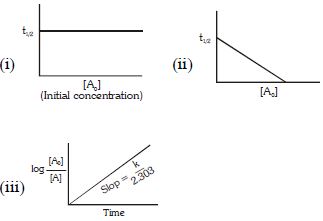
  • $(i),\,(iii)$
  • B
    $(i),\,(ii),\,(iii)$
  • C
    $(i)$ only
  • D
    $(iii),\, (ii)$

Answer

Correct option: A.
$(i),\,(iii)$
a
$t_{1/2}=\frac {0.693}{K}$

$log\frac {a}{a-x}=\frac {kt}{2.303}$

Need a full question paper?

Generate a complete, print-ready paper with questions like this in minutes — across 16+ boards, with answer keys.


Start Generating Free

Similar questions

Product $(B)$ is
At $1050$ $Kelvin$ , For chemical reaction $FeO_{(s)} + CO_{(g)}  \rightleftharpoons  Fe_{(s)} + CO_{2(g)} ; K_p = 0.25$ What are the equilibrium partial pressure of $CO_{(g)}$ and $CO_{2(g)}$ at $1050$ $Kelvin$ , if the initial partial pressure are ; $P_{{CO}_{( g)}}  = 1.6\, atm$ and $P_{{CO_2}_{( g )}} = 0.8\, atm$
Find the compound ' A ' from the following reaction sequences.
Image
Three isomers $A, B$ and $C$ (mol. formula $\left. C _{8} H _{11} N \right)$ give the following results

$A\,and\,C\,\xrightarrow{{{\text{Diazotization}}}}\,P + Q\,\xrightarrow[{(ii)\,oxidation\,\left( {KMn{O_4} + {H^ + }} \right)}]{{{\text{(i) Hydrolysis}}}}$$\begin{array}{*{20}{c}} {R\left( {product\,of\,A} \right)} \\ { + \,\,\,\,\,\,\,\,\,\,\,\,\,\,\,\,\,\,\,\,\,\,\,\,\,\,\,\,\,\,\,\,\,\,\,\,\,\,\,} \\ {s\,\left( {prosuct\,of\,C} \right)} \end{array}$

Assertion : Ethers behave as bases in the presence of mineral acids.
Reason : Due to the presence of lone pairs of electrons on oxygen
The correct order for acid strength of compounds $CH \equiv CH,\,C{H_3} - C \equiv CH,\,C{H_2} = C{H_2}$ is as follows
Identify wrong statement

$R - C \equiv C - R\xrightarrow{{Pd/BaS{O_4}}}A$

$R - C \equiv C - R\xrightarrow{{Na/Liq.\,NH_3}}B$

The electrode potentials for

$C{u^{2 + }}_{{\text{(aq)}}}\, + \,\,{e^ - }\, \to \,C{u^ + }_{{\text{(aq)}}}$

 and $C{u^+}_{{\text{(aq)}}}\, + \,\,{e^ - }\, \to \,C{u }_{{\text{(s)}}}$

are $+0.15\,V$ and $+0.50\,V$ respectively. The value of   will be ............ $\mathrm{V}$

The rate constant of a reaction at temperature $ 200\,K$ is $10$ times less than the rate constant at $400\,K.$  What is the activation energy $({E_a})$ of the reaction ($R =$  gas constant)
For the $n = 2$ energy level, how many orbitals of all kinds are possible