Question
In the following system of equation determine whether the system has a unique solution, no solution or infinitely many solutions. In case there is a unique solution, find it:
$x - 3y = 3$
$3x - 9y = 2$

Answer

The given system of equations may be written as,
$x - 3y - 3 = 0$
$3x - 9y - 2 = 0$
The given system of equations is of the form,
$a_1x + b_1y + c_1 = 0$
$a_2x + b_2y + c_2 = 0$
Where, $a_1 = 1, b_1 = -3, c_1 = -3$
And $a_2 = 3, b_2= -9, c_2 = -2$
We have,
$\frac{\text{a}_1}{\text{a}_2}=\frac{1}{3}$
$\frac{\text{b}_1}{\text{b}_2}=\frac{-3}{-9}=\frac{1}{3}$
And $\frac{\text{c}_1}{\text{c}_2}=\frac{-3}{-2}=\frac{3}{2}$
Clearly, $\frac{\text{a}_1}{\text{a}_2}=\frac{\text{b}_1}{\text{b}_2}\neq\frac{\text{c}_1}{\text{c}_2}$
So, the given system of equation has no solutions.

Need a full question paper?

Generate a complete, print-ready paper with questions like this in minutes — across 16+ boards, with answer keys.

Start Generating Free

Similar questions

The $26^{th}, 11^{th}$​​​​​​​ and last term of an A.P. are 0, 3 and $-\frac{1}{5},$ respectively. Find the common difference and the number of terms.
The difference of the squares of two numbers is 180. The square of the smaller number is 8 times the greater number. Find the two numbers.
Draw a $\triangle\text{ABC},$ right-angled at B such that AB = 3cm and BC = 4cm. Now, Construct a triangle a triangle similar to $\triangle\text{ABC},$ each of whose sides is $\frac75\text{times}$ the correponding side of $\triangle\text{ABC}.$
From the top of a $7 m$ high building, the angle of elevation of the top of a cable tower is $60^{\circ}$ and the angle of depression of its foot is $45^{\circ}$. Determine the height of the tower.
Find the missing frequency f1 and f2 in the following distribution table, if N = 100 and median is 32.
Class:0-1010-2020-3030-4040-5050-60Total
Frequency:10F12530F210100
Draw a right triangle in which sides (other than the hypotenuse) are of lengths 8cm and 6cm. Then construct another triangle whose sides are $\frac{3}{4}$ times the corresponding sides of the first triangle.
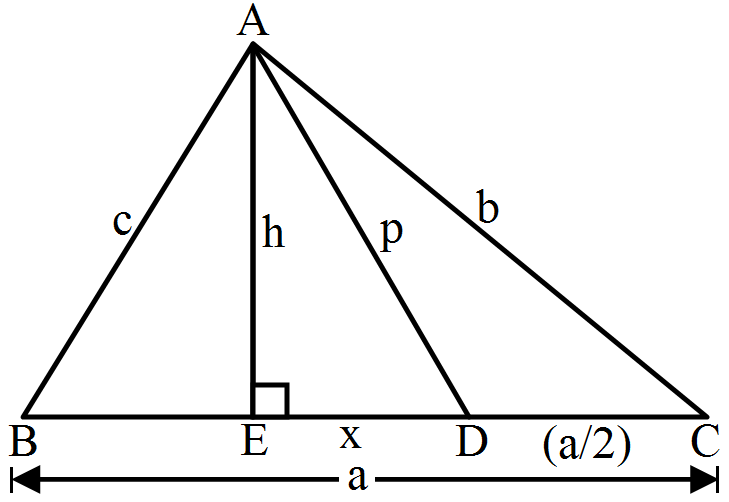
In the given figure, D is the midpoint of side BC and $\text{AE}\perp\text{BC}.$ If BC = a, AC = b, AB = c, ED = x, AD = p and AE = h, prove that.

$\text{b}^2=\text{p}^2+\text{ax}+\frac{\text{a}^2}{4}$
Construct a $\triangle\text{ABC},$ in which BC = 5cm, $\angle\text{C}=60^\circ$ and altitude from A is equal to 3cm. Construct a $\triangle\text{ADE}$ similar to $\triangle\text{ABC},$ such that each side of $\triangle\text{ADE}$ is $\frac32$ times the corresponding side of $\triangle\text{ABC}$ Write the steps of construction.
For each of the following, find a quadratic polynomial whose sum and product respectively of the zeroes are as given. Also find the zeroes of these polynomials by factorisation.
$\frac{-8}{3}$, $\frac{4}{3}$
Show that the line segment which joins the midpoint of the oblique sides of a trapezium is parallel to the parallel sides.