MCQ
In the formula $\overline{\text{X}}=\text{a}+\frac{\sum\text{f}_\text{i}\text{d}_\text{i}}{\sum\text{f}_\text{i}}$ for finding the mean of grouped data di’s are deviations from a of:
  • A
    lower limits of classes.
  • B
    upper limits of classes.
  • mid-points of classes.
  • D
    frequency of the class marks .

Answer

Correct option: C.
mid-points of classes.
We know that, $d_i = x_i – a$
i .e , $d_i$‘s are the deviation from a mid$-$points of the classes.

Need a full question paper?

Generate a complete, print-ready paper with questions like this in minutes — across 16+ boards, with answer keys.

Start Generating Free

Similar questions

Each question consists of two statements, namely, Assertion $(A)$ and Reason $(R)$. for selecting the correct answer, use the following code:
Assertion (A)
Reason (R)
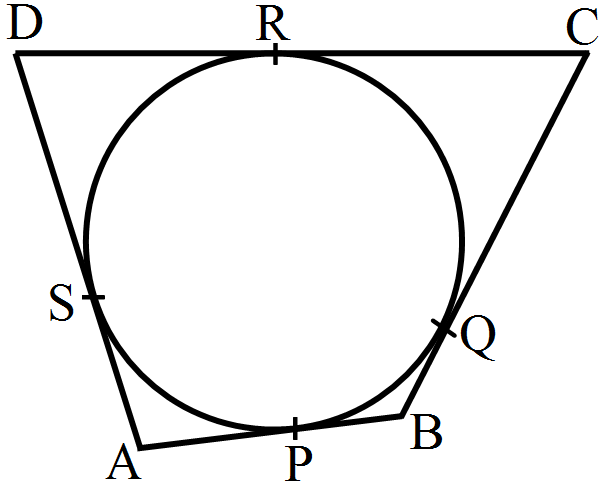
In the given figure, a quad. $\text{ABCD}$ is drawn to circumscribe a given circle as shown. Then, $\text{AB + BC = AD + DC.}$ In two concentric circles, the chord of the larger circle, which to uches the smaller circle, is bisected at the point of contact.
The zeros of the quadratic polynomial $x^2 + 88x + 125$ are:
If $FV < MV$ the share is at _____ .
If $\alpha$ and $\beta$ are the zero of $x^2 + 5x + 8$, then the value of $(\alpha+\beta)$ is:
Mark the correct alternative in the following:
The common difference of the $A.P. \frac{1}{2\text{b}},\frac{1-6\text{b}}{2\text{b}},\frac{1-12\text{b}}{2\text{b}}, .....$ is 
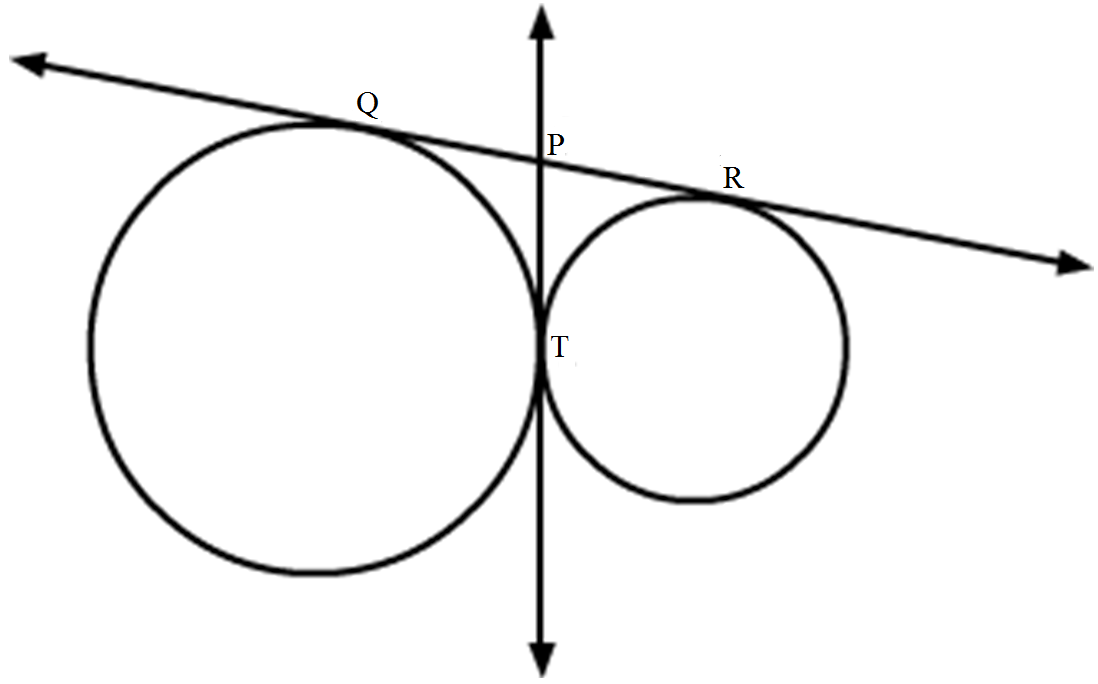
In the given figure, $\text{QR}$ is a common tangent to the given circles touching externally at the point $T.$ The tangent at $T$ meets $\text{QR}$ at $P.$ If $\text{PT} = 3.8\ cm,$ then the length of $\text{QR} ($ in $cm)$ is:
$\frac{\tan35^\circ}{\cot55^\circ}+\frac{\cot78^\circ}{\tan12^\circ}=?$
A reservoir is in the shape of a frustum of a right circular cone. It is $8m$ across at the top and $4m$ across at the bottom. If it is $6m$ deep, then its capacity is:
For some integer $m,$ every even integer is of the form:
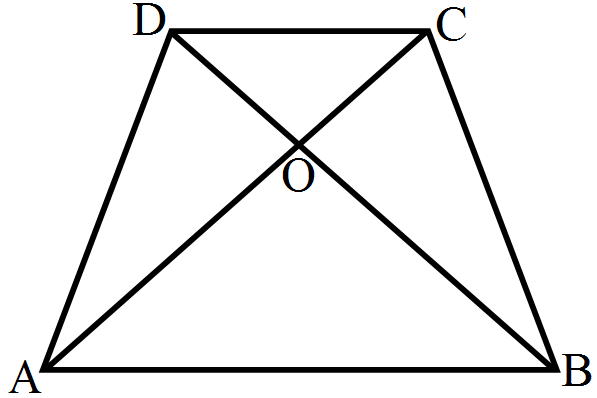
In the given figure, $\text{ABCD}$ is a trapezium whose diagonals $\text{AC}$ and $\text{BD}$ intersect at $O$ such that $OA = (3x - 1)cm, OB = (2x + 1)cm, OC = (5x - 3)cm$ and $OD (6x - 5)cm.$ Then $x =?$