MCQ
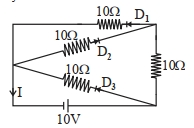
In the given circuit, the current $(I)$ through the battery will be $..........\,A$
  • $1.5$
  • B
    $1$
  • C
    $2.5$
  • D
    $2$

Answer

Correct option: A.
$1.5$
a
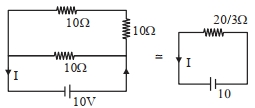
In the circuit $D_1$ and $D_3$ are forward biased and $D_2$ is reverse biased.

$\therefore I =\frac{10}{20 / 3}=\frac{3}{2}\,A =1.5\,A$
Need a full question paper?

Generate a complete, print-ready paper with questions like this in minutes — across 16+ boards, with answer keys.
Start Generating Free

Similar questions

A point charge of 40 stat coulomb is placed 2 cm in front of an earthed metallic plane plate of large size. Then the force of attraction on the point charge is
A person travelling on a straight line moves with a uniform velocity $v_1$ for a distance x and with a uniform velocity $v_2$ for the next equal distance. The average velocity v is given by:
In the circuit shown in the figure, the current through
Assertion : A person touching a high power line gets stuck with the line.
Reason : The current carrying wires attract the man towards it.
Equal potentials are applied on an iron and copper wire of same length. In order to have the same current flow in the two wires, the ratio r (iron)/r (copper) of their radii must be (Given that specific resistance of iron = $1.0 \times 10^{-7}$ ohm–m and specific resistance of copper = $1.7 \times 10^{-8}$ ohm-m)
The maximum velocity of an electron emitted by light of wavelength $\lambda $ incident on the surface of a metal of work function $\phi ,$ is

Where $h =$ Planck's constant, $m =$ mass of electron and $c =$ speed of light.

A $280$ ohm electric bulb is connected to $200V$ electric line. The peak value of current in the bulb will be
A thin equiconvex lens is made of glass of refractive index $1.5$ and its focal length is $0.2 m,$ if it acts as a concave lens of $0.5 m$ focal length when dipped in a liquid, the refractive index of the liquid is
A primary cell has an e.m.f. of 1.5 volts, when short-circuited it gives a current of 3 amperes. The internal resistance of the cell is
Maxwell’s equations describe the fundamental laws of