MCQ
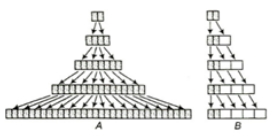
In the given diagram, what does $A$ and $B$ indicates?

Choose the correct option
  • A
    $A-$ Mitosis; $B-$ Meiosis
  • B
    $A-$ Arithmetic growth; $B-$ Geometric growth
  • $A-$ Geometric growth; $B-$ Arithmetic growth
  • D
    $A-$ Multiplicative phase; $B-$ Replicative growth

Answer

Correct option: C.
$A-$ Geometric growth; $B-$ Arithmetic growth
c

Need a full question paper?

Generate a complete, print-ready paper with questions like this in minutes — across 16+ boards, with answer keys.

Start Generating Free

Similar questions

Which of the following does not evolve oxygen
Heterospory has been reported in:
During the meiotic division the
Which of the following statements about enzymes are true ?
(i) Enzymes do not alter the overall change in free energy for a reaction.
(ii) Enzymes are proteins whose three dimensional shape is key to their functions.
(iii) Enzymes speed up reactions by lowering activation energy.
(iv) Enzymes are highly specific for reaction.
(v) The shape of an enzyme does not effect its activity.
(vi) The energy input needed to start a chemical reaction is called activation energy.
How many meiotic divisions will be necessary to produce two hundred pollen grains
Which of the following is largest in size:
What happens to the growth of roots during water logging conditions?
Given below are two statements
Statement I: Joints are points of contact between bones or between bones and cartilages.
Statement II : Force generated by the muscles is used to carry out movement through joints, where the joint act as a fulcrum.
Choose the correct answer from the option given below:
Statement I: Difference in shapes of leaves produced juvinile and mature plant in buttercup.
Statement II: Buttercup represent the heterophyllous development due to environment.
Match the following enzymes with their functions

$(a)$ Restriction endonuclease  $(i)$ Joins the $DNA$ fragements
$(b)$ Restriction exonuclease  $(ii)$ Extends primers on genomic $DNA$ template
$(c)$ $DNA$ ligase  $(iii)$ Cuts $DNA$ at specific position
$(d)$ Taq polymerase  $(iv)$ Removes nucleotides from the ends of $DNA$

Select the correct option from the following