Question
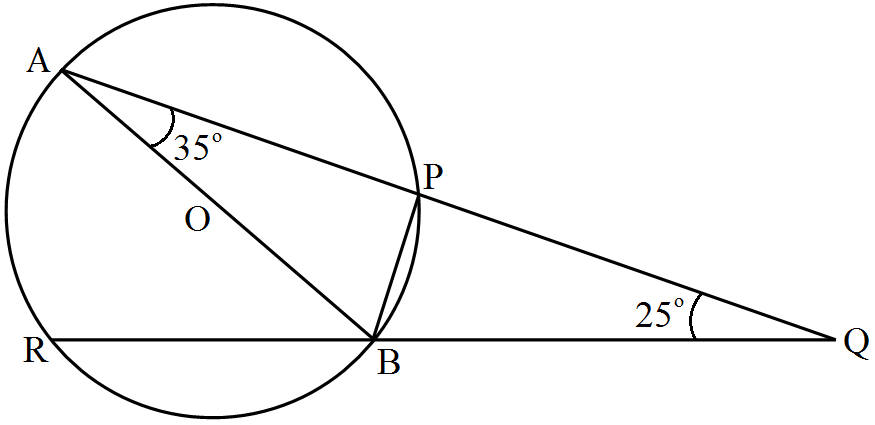
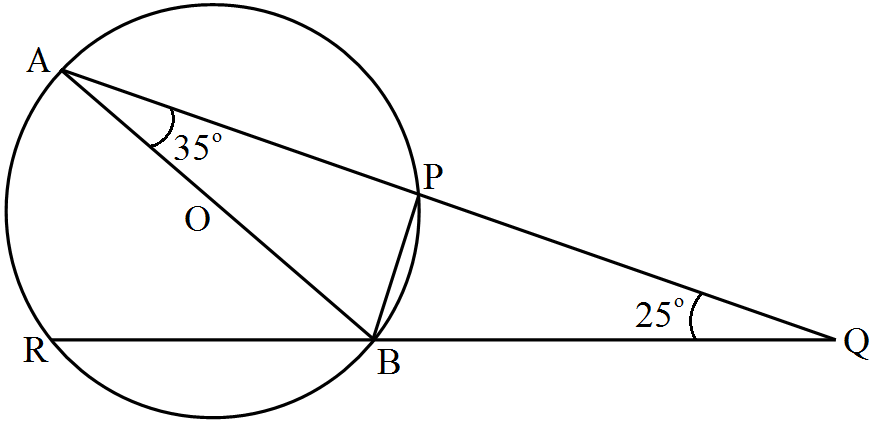
In the given figure, $AB$ is a diameter of the circle such that $\angle\text{A}=35^\circ$ and $\angle\text{Q}=25^\circ,$ find $\angle\text{PBR.}$
 

Answer

Let us first consider the triangle $\triangle\text{ABQ}.$

It is known that in a triangle the sum of all the interior angles add up to $180^\circ .$
So here in our triangle $\triangle\text{ABQ}$
we have, $\angle\text{BAQ}+\angle\text{AQB}+\angle\text{ABQ}=180^\circ$
$\angle\text{ABQ}=180^\circ-\angle\text{BAQ}-\angle\text{AQB}$
$=180^\circ-35^\circ-25^\circ$
$\angle\text{ABQ}=120^\circ$ By a property of the circle we know that an angle formed in a semi-circle will be $90^\circ .$
 In the given circle since $‘AB’$ is the diameter of the circle the angle $\angle\text{APB}$ which is formed in a semi-circle will have to be $90^\circ .$
So, we have $\angle\text{APB}=90^\circ$
Now considering the triangle $\triangle\text{APB}$
we have, $\angle\text{APB}+\angle\text{BAP}+\angle\text{ABP}=180^\circ$
$\angle\text{APB}=180^\circ-\angle\text{APB}-\angle\text{BAP}$
$=180^\circ-90^\circ-35^\circ$
$\angle\text{ABP}=55^\circ$ From the given figure it can be seen that,
$\angle\text{ABP}+\angle\text{PBQ}=\angle\text{ABQ}$
$\angle\text{PBQ}=\angle\text{ABQ}-\angle\text{ABP}$
$=120^\circ-55^\circ$
$\angle\text{PBQ}=65^\circ$
Now, we can also say that, $\angle\text{PBQ}+\angle\text{PBR}=180^\circ$
$\angle\text{PBR}=180^\circ-\angle\text{PBQ}$
$=180^\circ-65^\circ$
$\angle\text{PBR}=115^\circ$
​​​​​​​Hence the measure of the angle $\angle\text{PBR}$ is $115^\circ .$

Need a full question paper?

Generate a complete, print-ready paper with questions like this in minutes — across 16+ boards, with answer keys.

Start Generating Free

Similar questions

Sanya has a piece of land which is in the shape of a rhombus. She wants her one daughter and one son to work on the land and produce different crops. She divided the land in two equal parts. If the perimeter of the land is $400 \ m$ and one of the diagonals is $160 \ m$, how much area each of them will get for their crops?
The following data gives the demand estimates of the Government of India, Department of Electronics for the personnel in the Computer sector during the Eighth Plan period $(1990–95):$
Qualifications
$MCA ($Masters in Computer Applications$)$
$DCA ($Diploma in Computer Applications$)$
$DCE ($Diploma in Computer Engineering$)$
$CL ($Certificate Level Course$)$
$ST ($Short Term Course$)$
Personnel required
$40600$
$181600$
$18600$
$670600$
$1802900$
Represent the data with the help of a bar graph. Indicate with the help of the bar graph the course where the estimated requirement is least.
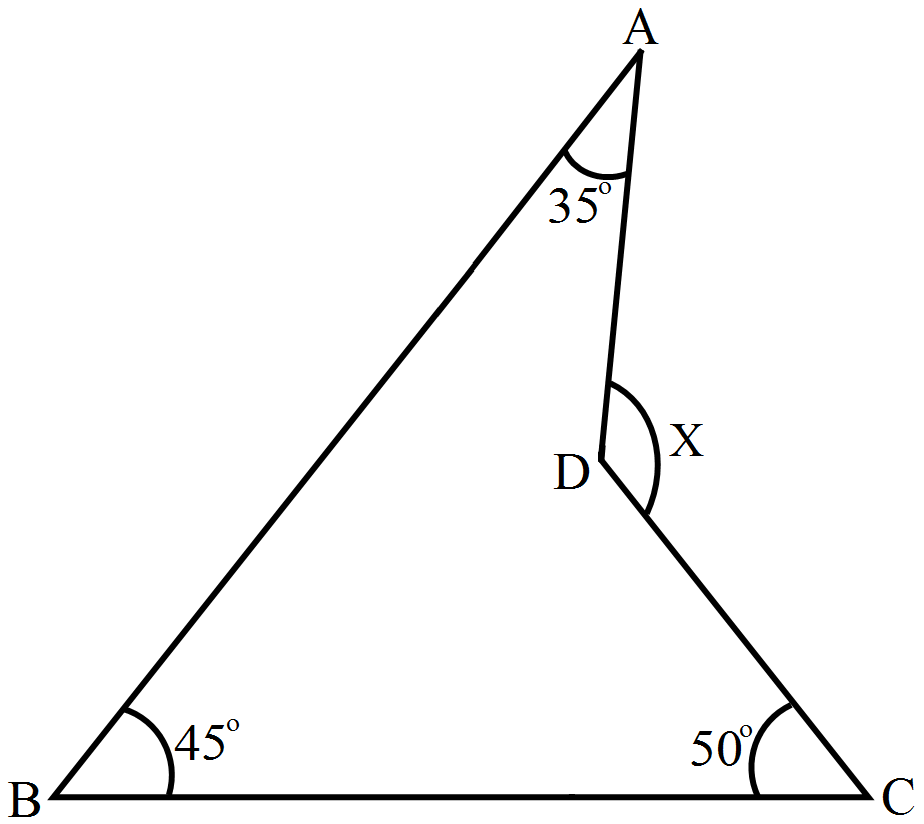
In the given figure, compute the value of $x.$
Find the percentage increase in the area of a triangle if its each side is doubled.
If the mean of the following data is $8$, find the value of $p$.
x
$3$
$5$
$7$
$9$
$11$
$13$
f
$6$
$8$
$15$
$p$
$8$
$4$
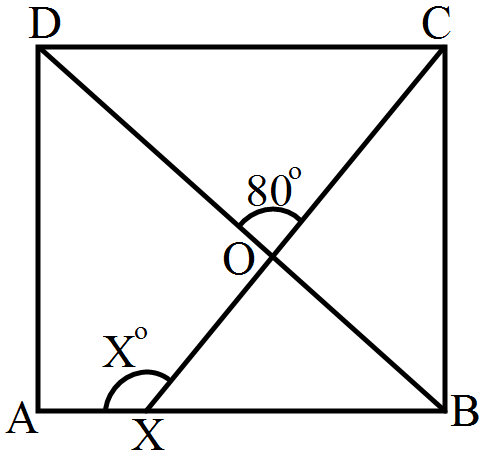
In the adjoining figure, $ABCD$ is a square. $A$ line segment $CX$ cuts $AB$ at $X$ and the diagonal $BD$ at $O$ such that $\angle\text{COD}=80^{\circ}$ and $\angle\text{OXA}=\text{x}^{\circ}.$ Find the value of x.
If $p(y) = 4 - 3y -y^2 + 5y^3$, find:
$i. p(0)$
$ii. p(2)$
$iii. p(-1)$
Using factor theorem, factorize the polynomial: $x^3-6 x^2+3 x+10$
$1500$ families with $2$ children were selected randomly, and the following data were recorded:
No of girls in a family $0$ $1$ $2$
No of girls $211$ $814$ $475$
If a family is chosen at random, compute the probability that it has:
$1.$ No girl.
$2. 1$ girl.
$3. 2$ girls.
$4.$ At most one girl.
$5.$ More girls than boys.