Question
In the given figure,
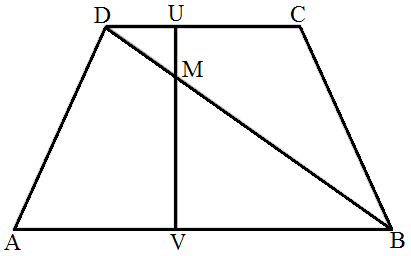
AB || DC prove that
$\triangle\text{DMU}\sim\triangle\text{BMV}$
Answer

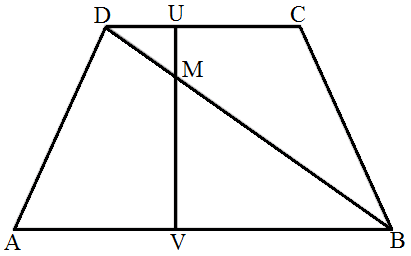
Given, AB || DC In triangle DMU and BMV, we have $\angle\text{MUD}=\angle\text{MVB}$ Each angle is equal to 90° $\angle\text{UMD}=\angle\text{VMB}$ Each are vertically opposite angles. Therefore, by AA-criterion of similarity $\triangle\text{DMU}\sim\triangle\text{BMV}$

Need a full question paper?

Generate a complete, print-ready paper with questions like this in minutes — across 16+ boards, with answer keys.

Start Generating Free

Similar questions

If the mean of the frequency distribution is 8.1 and ∑𝑓𝑖𝑥𝑖 = 132 + 5k, ∑ 𝑓𝑖= 20 then find K.
Find the value of discriminant for each of the following equation.
$2 y^2-y+2=0$
A bag contains lemon flavoured candies only. Malini takes out one candy without looking into the bag. What is the probability that she takes out:
  1. An orange flavoured candy?
  2. A lemon flavoured candy?
Prove the following identites:
$\sin^2\theta+\frac{1}{\big(1+\tan^2\theta\big)}=1$
The area of a circle is $98.56 \text {cm}^2$ find its circumference. $\Big[\text{Use }\pi=\frac{22}{7}\Big]$
Determine the nature of roots for each of the quadratic equation.
$m^2-2 m+1=0$
Write the median class of the following distribution:
Classes
0-10
10-20
20-30
30-40
40-50
50-60
60-70
Frequency
4
4
8
10
12
8
4
Prove that angles inscribed in the same arc are congruent.

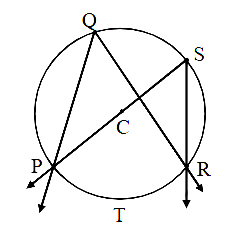
Given: In a circle with center $C, \angle P Q R$ and $\angle P S R$ are inscribed in same arc PQR. Arc PTR is intercepted by the angles.
To prove: $\angle P Q R \cong \angle P S R$.
Proof:
$ m \angle PQR =\frac{1}{2} \times[ m (\operatorname{arc} PTR )]$
$m \angle \square=\frac{1}{2} \times[ m (\operatorname{arc} PTR )] \ldots . . . \text { (ii) } \square$
$m \angle \square= m \angle PSR \quad \ldots . . .[ By \text { (i) and (ii) }]$
$\therefore \angle PQR \cong \angle PSR $
Define a polynomial with real coefficients.
A bag contains 18 balls out of which x balls are red.
  1. If one ball is drawn at random from the bag, what is the probability that it is not red?
  2. If two more red balls are put in the bag, the probability of drawing a red ball will be $\frac{9}{8}$ times the probability of drawing a red ball in the first case. Find the value of x.