Question
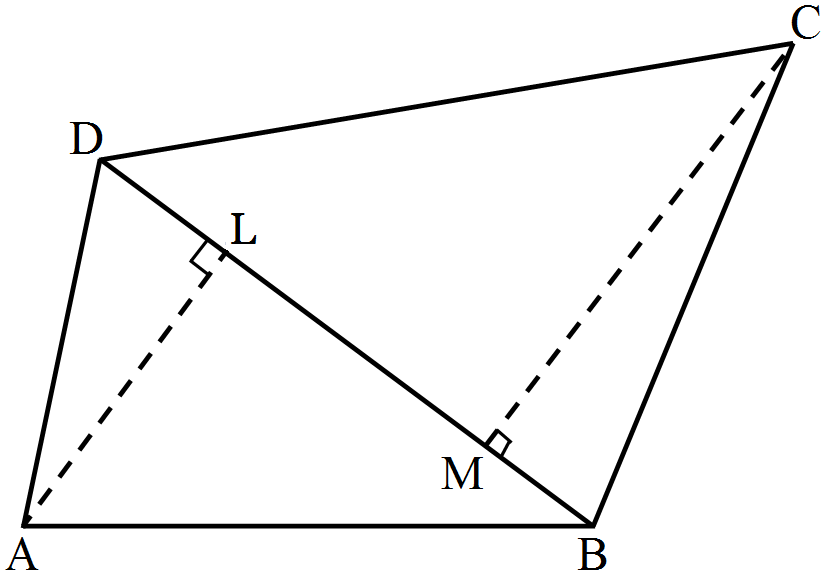
In the given figure, ABCD is a quadrilateral in which diagonal $BD = 24\ cm$, $\text{AL}\perp\text{BD}$ and $\text{CM}\perp\text{BD}$ such that $AL = 9\ cm$ and $CM = 12\ cm$. Calculate the area of the quadrilateral.
Answer

Given,
$BD = 24\ cm$
$AL = 9\ cm$
$CM = 12\ cm$
Area of $\triangle\text{BCD}=\frac{1}{2}\times\text{BD}\times\text{CD}$
$=\frac12\times24\times12=144\text{cm}^2$
Area of $\triangle\text{DAB}=\frac{1}{2}\times\text{BD}\times\text{AL}$
$=\frac12\times24\times9=108\text{cm}^2$
Now, area of quadrilateral ABCD = Area of $\triangle\text{BCD}$ + Area of $\triangle\text{DAB}$
$= (144 + 108)cm^2$
$= 252\ cm^2$

Need a full question paper?

Generate a complete, print-ready paper with questions like this in minutes — across 16+ boards, with answer keys.
Start Generating Free

Similar questions

A copper sphere of diameter 18cm is drawn into a wire of diameter 4mm. Find the length of the wire.
A 16m deep well with diameter 3.5m is dug up and the earth from it is spread evenly to form a platform 27.5m by 7m. Find the height of the platform.
A tent is in the form of a right circular cylinder surmounted by a cone. The diameter of the base of the cylinder or the cone is $24\ m$. The height of the cylinder is $11\ m$. If the vertex of the cone is 16m above the ground, find the area of the canvas required for making the tent. $(\text{Use}\ \pi=\frac{22}{7})$
Mr. Gokhale invested ₹ 22,500 in shares of face value ₹ 100 at market value ₹ 125. If the company declared $60 \%$ dividend at the end of the year, what was the income from dividend?
ΔLMN ~ ΔPQR, 9 × A(ΔPQR) = 16 × A (ΔLMN). If QR = 20 then find MN.
ABCD is a trapezium having AB || DC. Prove that O, the point of intersection of diagonals, divides the two diagonals in the same ratio. Also prove that $\frac{\text{ar}(\triangle\text{OCD})}{\text{ar}(\triangle\text{OAB})}=\frac{1}{9},$ if AB = 3CD.
In a quadrilateral $A B C D, \angle B=90^{\circ}$. If $A D^2=A B^2+B C^2+C D^2$, then prove that $\angle A C D=90^{\circ}$.
Apply division algorithm to find the quotient $q(x)$ and remainder $r(x)$ in dividing $f(x)$ by $g(x)$ in the following:f( $x)=$ $15 x^3-20 x^2+13 x-12, g(x)=2-2 x+x^2$
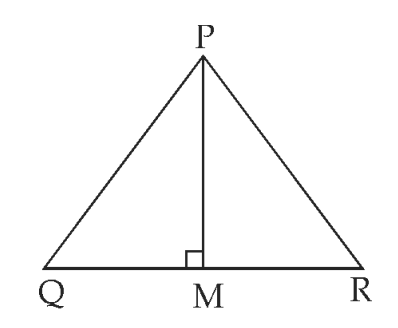
$\triangle PQR$ is an equilateral triangle, seg PM$ \perp$ side QR , Q-M-R. Prove that : $PQ ^2=4 QM ^2$
Image
If $3$ is a root of the quadratic equation $x^2 - x + k = 0$, find the value of p so that the roots of the equation $x^2+ k(2x + k + 2) + p = 0$ are equal.