MCQ
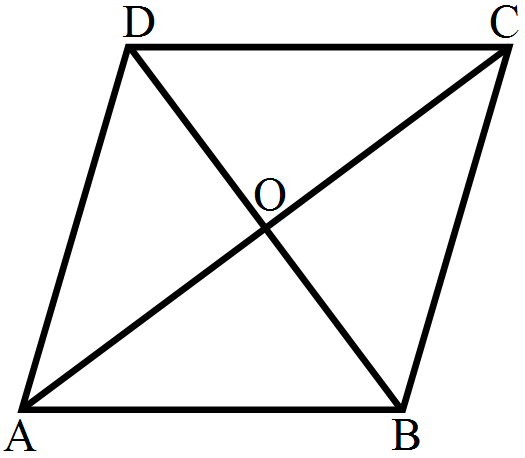
In the given figure, $ABCD$ is a rhombus. Then:
- A$A C^2+B D^2=A B^2$
- B$A C^2+B D^2=2 A B^2$
- ✓$A C^2+B D^2=4 A B^2$
- D$2\left(A C^2+B D^2\right)=3 A B^2$
The diagonals of a rhombus bisect each other at right angles.
$\Rightarrow\text{OA}=\frac{1}{2}\text{AC}$ and $\text{OB}=\frac{1}{2}\text{BD}$
Also, $\angle\text{AOB}=90^{\circ}$
In right $\triangle\text{AOB},$
$\therefore\text{AB}^2=\text{OA}^2+\text{OB}^2$ ...(By Pythagoras theorem)
$\Rightarrow\text{AB}^2=\frac{1}{4}\text{AC}^2+\frac{1}{4}\text{BD}^2$
$\Rightarrow\text{AC}^2+\text{BD}^2=4\text{AB}^2$
Generate a complete, print-ready paper with questions like this in minutes — across 16+ boards, with answer keys.