MCQ
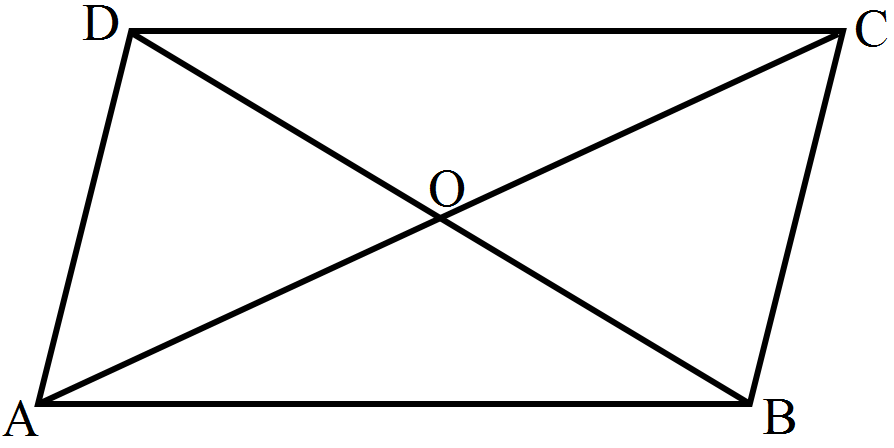
In the given figure, $ABCD$ is a Rhombus. Then,
- A$\left(A C^2+B D^2\right)=3 A B^2$
- ✓$\mathrm{AC}^2+\mathrm{BD}^2=4 \mathrm{AB}^2$
- C$\mathrm{AC}^2+\mathrm{BD}^2=\mathrm{AB}^2$
- D$\mathrm{AC}^2+\mathrm{BD}^2=2 \mathrm{AB}^2$
$ABCD$ is a rhombus. $AB = BC = CD = DA$
In Rhombus, diagonals bisect each other at right angles.
So, $AO= CO$ and $BO = DO$
In triangle $\mathrm{AOB} \times \mathrm{AO} \mathrm{F}^2+\mathrm{BO}^2=\mathrm{AB}^2$ (Pythagoras theorem)
$\Big(\frac{1}{2}\text{AC}\Big)^2 + \Big(\frac{1}{2}\text{BD}\Big)^2 = \text{AB}^2$
$\frac{\text{AC}^2}{4} + \frac{\text{BD}^2}{4} = \text{AB}^2$
$=A C^2+B D^2=4 A B^2$
Generate a complete, print-ready paper with questions like this in minutes — across 16+ boards, with answer keys.