Question
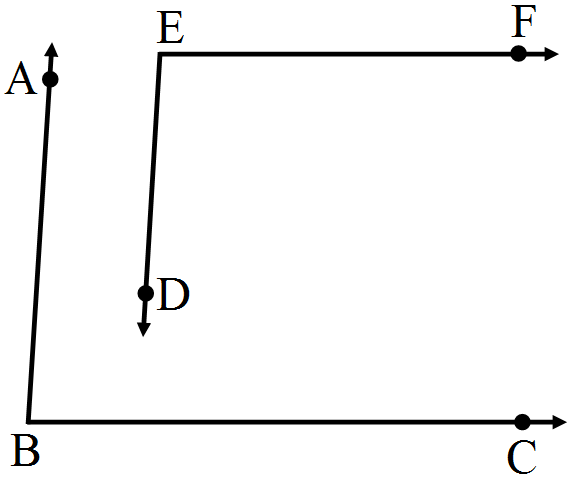
In the given figure, BA || ED and BC || EF. Show that $\angle\text{ABC}+\angle\text{DEF}=180^\circ.$
Answer

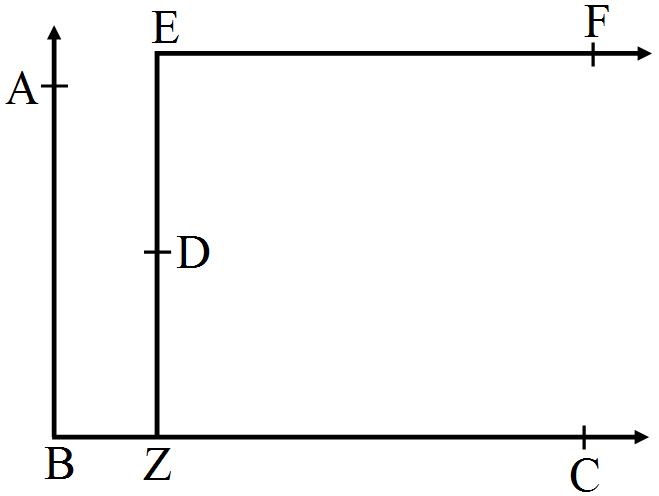
Construction: Produce ED to meet BC at Z. Now, AB || EZ and BC is the transversal.$\Rightarrow\angle\text{ABZ}+\angle\text{EZB}=180^\circ$ (interior angles)
$\Rightarrow\angle\text{ABC}+\angle\text{EZB}=180^\circ\ .....(\text{i)}$
Also, EF || BC and EZ is the transversal.$\Rightarrow\angle\text{BZE}=\angle\text{ZEF}$ (alternate angles)
$\Rightarrow\text{BZE}=\angle\text{DEF}\ .....(\text{ii)}$
From (i) and (ii), we have$\angle\text{ABC}+\angle\text{DEF}=180^\circ$

Need a full question paper?

Generate a complete, print-ready paper with questions like this in minutes — across 16+ boards, with answer keys.

Start Generating Free

Similar questions

A company selected 2400 families at random and surveys them to determine a relationship between income level and the number of vehicles in a home. The information gathered is listed in the table below:
Monthly Income
(in ₹)
Vechicles Per Family
0
1
2
Above 2
Less than 7000
10
160
25
0
7000 – 10000
0
305
27
2
10000 – 13000
1
535
29
25
13000 – 16000
2
469
29
25
16000 or more
1
579
82
88
If a family is chosen, find the probability that the family is:
  1. Earning ₹ 10000 - 13000 per month and owning exactly 2 vehicles.
  2. Earning ₹ 16000 or more per month and owning exactly 1 vehicle.
  3. Earning less than ₹ 7000 per month and does not own any vehicle.
  4. Earning ₹ 13000 - 16000 per month and owning more than 2 vehicles.
  5. Owning not more than 1 vehicle.
  6. Owning at least one vehicle.
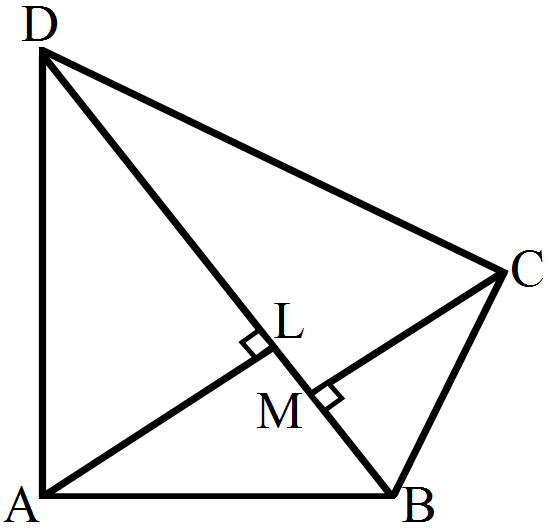
BD is one of the diagonals of a quadrilaterl ABCD. If $\text{AL}\perp\text{BD}$ and $\text{CM}\perp\text{BD},$show that
ar(quadrilaterl ABCD) $=\frac{1}{2}\times\text{BD}\times(\text{AL}+\text{CM}).$
A well with 10m inside diameter is dug 8.4m deep. Earth taken out of it is spread all around it to a width of 7.5m to form an embankment. Find the height of the embankment.
If $\sin \theta=\frac{4}{5}$, then find $\cos \theta$.
If two straight lines intersect each other, prove that the ray opposite to the bisector of one of the angles thus formed bisects the vertically opposite angle.
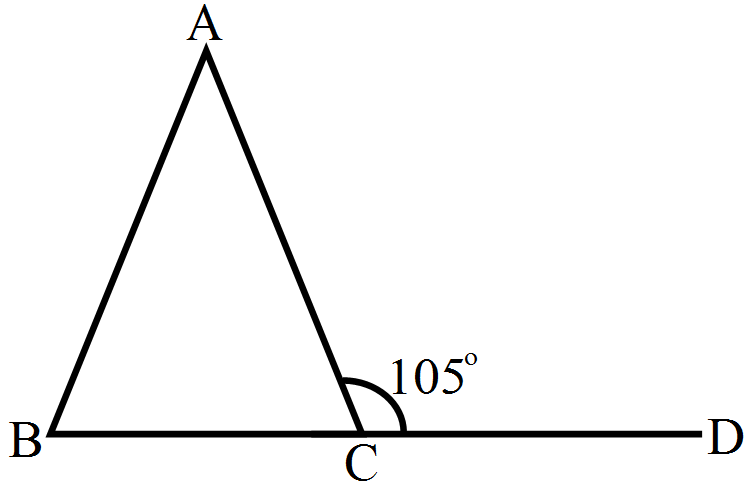
In Fig. $\text{AB}=\text{AC}$ and $\angle\text{ACD}=105^\circ,$ find $\angle\text{BAC}.$
Rationalise the denominator of the following:$\frac{4}{2+\sqrt{3}+\sqrt{7}}$
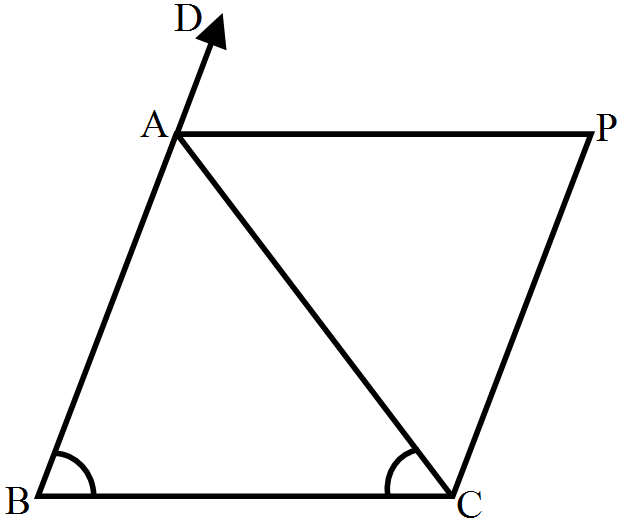
In figure, AB = AC and CP ∥ BA and AP is the bisector of exterior $\angle\text{CAD}$ of $\triangle\text{ABC}.$ Prove that:
  1. $\angle\text{PAC}=\angle\text{BCA}.$
  2. ABCP is a parallelogram.
Simplify:$\frac{7+3\sqrt5}{3+\sqrt5}-\frac{7-3\sqrt5}{3-\sqrt5}$
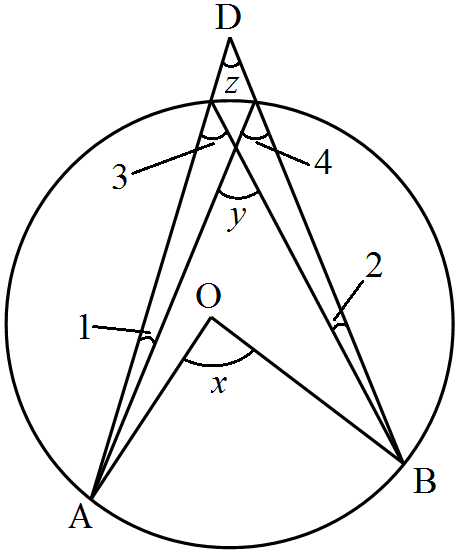
In figure, O is the centre of the circle, then prove that $\angle\text{x}=\angle\text{y}+\angle\text{z}.$