Question
Need a full question paper?
Generate a complete, print-ready paper with questions like this in minutes — across 16+ boards, with answer keys.
Explore more
Similar questions
Draw, in the same diagram, a histogram and a frequency polygon to represent the following data which shows the monthly cost of living index of a city in a period of $2$ years:
→| Cost of living inex: | $440-460$ | $460-480$ | $480-500$ | $500-520$ | $520-540$ | $540-560$ | $560-580$ | $580-600$ |
| No.of months: | $2$ | $4$ | $3$ | $5$ | $3$ | $2$ | $1$ | $4$ |
In square $\text{ABCD}$, $P$ and $Q$ are mid-point of $AB$ and $CD$ respectively. If $AB = 8\ cm$ and $PQ$ and $BD$ intersect at $O$, then find area of $(\triangle\text{OPB}).$
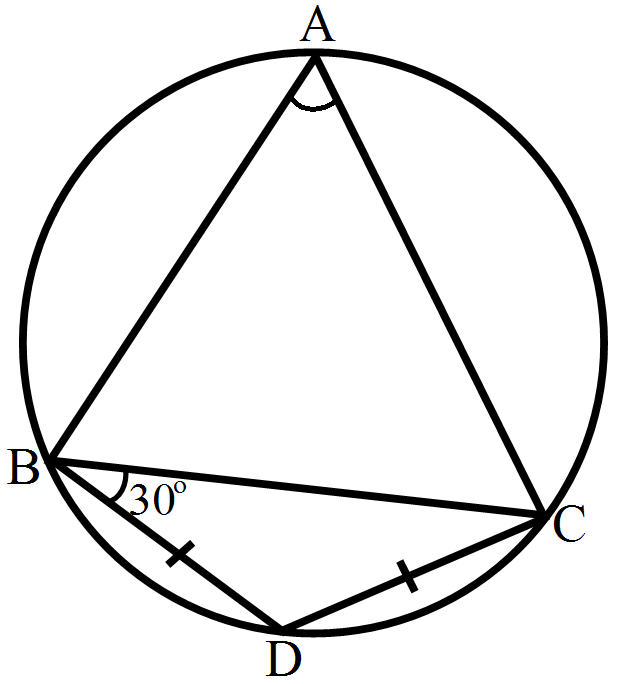
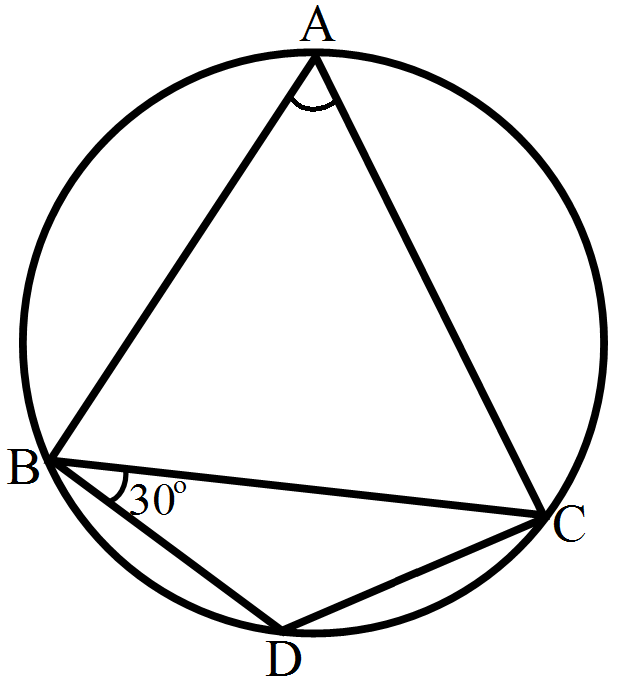
→ABCD is a cyclic qudrilateral in which:
$\angle\text{BCD}=100^\circ$ and $\angle\text{ABD}=70^\circ$ find $\angle\text{ADB}.$
→$\angle\text{BCD}=100^\circ$ and $\angle\text{ABD}=70^\circ$ find $\angle\text{ADB}.$
The curved surface area of a cylinder is $1320\ cm^2$ and its base had diameter $21\ cm$. Find the height and volume of the cylinder.
→Heights (in cm) of $30$ students of class $IX$ are given below: $155, 158, 154, 158, 160, 148, 149, 150, 153, 159, 161, 148, 157, 153, 157, 162, 159, 151, 154, 156, 152, 156, 160, 152, 147, 155, 163, 155, 157, 153$. Prepare a frequency distribution table with $160-164$ as one of the class intervals.
→Find rational numbers $a$ and $b$ such that: $\frac{5+2\sqrt{3}}{7+4\sqrt{3}}=\text{a}+\text{b}\sqrt{3}$
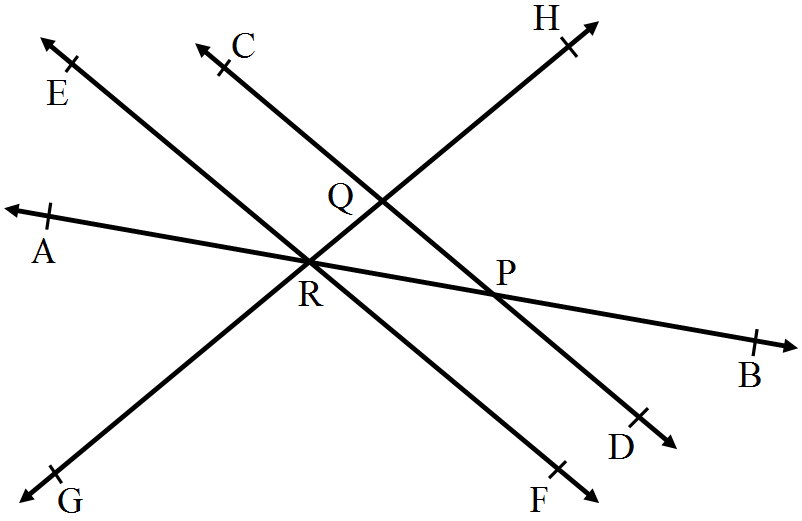
→In the adjoining figure, name:
$i.$ Two pairs of intersecting lines and their corresponding points of intersection.
$ii.$ Three concurrent lines and their points of intersection.
$iii.$ Three rays.
$iv.$ Two line segments.
→$i.$ Two pairs of intersecting lines and their corresponding points of intersection.
$ii.$ Three concurrent lines and their points of intersection.
$iii.$ Three rays.
$iv.$ Two line segments.
The marks scored by $55$ students in a test are given below:
Prepare a cumulative frequency table.
→|
Marks
|
$0-5$
|
$5-10$
|
$10-15$
|
$15-20$
|
$20-25$
|
$25-30$
|
$30-35$
|
|
No. of students
|
$2$
|
$6$
|
$13$
|
$17$
|
$11$
|
$4$
|
$2$
|
Find rational numbers $a$ and $b$ such that: $\frac{2-\sqrt{5}}{2+\sqrt{5}}=\text{a}\sqrt{5}+\text{b}$
→Following data gives the number of children in $40$ families: $1, 2, 6, 5, 1, 5, 1, 3, 2, 6, 2, 3, 4, 2, 0, 0, 4, 4, 3, 2, 2, 0, 0, 1, 2, 2, 4, 3, 2, 1, 0, 5, 1, 2, 4, 3, 4, 1, 6, 2, 2.$ Represent it in the form of a frequency distribution.
→