MCQ
In the given figure, equivalent resistance between A and B will be
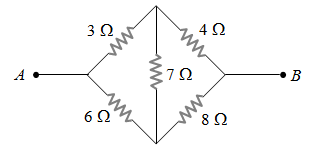
  • $\frac{14}{3} \Omega$
  • B
    $\frac{3}{14} \Omega$
  • C
    $\frac{9}{14} \Omega$
  • D
    $\frac{14}{9} \Omega$

Answer

Correct option: A.
$\frac{14}{3} \Omega$
(a) $\frac{14}{3} \Omega$

Need a full question paper?

Generate a complete, print-ready paper with questions like this in minutes — across 16+ boards, with answer keys.

Start Generating Free

Similar questions

A lens of power $+2$ diopters is placed in contact with a lens of power $-1$ diopter. The combination will behave like
Given below are two statements : one is labelled as Assertion $A$ and the other is labelled as Reason $R$

Assertion $A :$ Photodiodes are preferably operated in reverse bias condition for light intensity measurement.

Reason $R$ : The current in the forward bias is more than the current in the reverse bias for a $p - n$ junction diode.

In the light of the above statement, choose the correct answer from the options given below :
In a triode amplifier, $\mu=25, r_P=40$ kilo ohm and load resistance $R_L=10$ kilo ohm. If the input signal voltage is 0.5 volt, then output signal voltage will be
The ozone layer absorbs
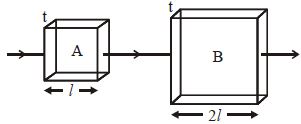
Two square metal plates $A$ and $B$ are of the same thickness and material. The side of $B$ is twice that of $A$. These are connected as shown in series. If the resistances of $A$ and $B$ are denoted by $R_A$ and $R_B,$ then $(R_A/R_B)$ is
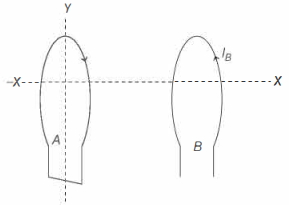
The diagram below shows two circular loops of wire ( $A$ and $B$ ) centred on and perpendicular to the $X$-axis and oriented with their planes parallel to each other. The $Y$-axis passes vertically through loop $A$ (dashed line). There is a current $I_B$ in loop $B$ as shown in the diagram. Possible actions which we might perform on loop $A$ are

$(I)$ move $A$ to the right along $X$-axis closer to $B$

$(II)$ move $A$ to the left along $X$-axis away from $B$

$(III)$ as viewed from above, rotate $A$ clockwise about $Y$-axis

$(IV)$ as viewed from above, rotate $A$ anti-clockwise about $Y$-axis

Which of the actions will induce a current in $A$ only in the direction shown?
Two very long, straight, parallel conductors $A$ and $B$ carry current of $5\,A$ and $10\,A$ respectively and are at a distance of $10\,cm$ from each other. The direction of current in two conductors is same. The force acting per unit length between two conductors is: $\left(\mu_0=4 \pi \times 10^{-7}\right.$ SI unit)
A circular coil of radius 5 cm has 500 turns of a wire. The approximate value of the coefficient of self induction of the coil will be
Correct relation for triode is
The coefficient of self induction of a coil is given by.