Question
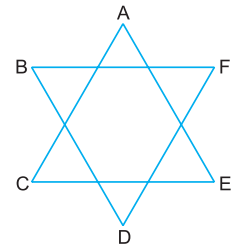
In the given figure, find $\angle A +\angle B +\angle C +$ $\angle D +\angle E +\angle F$.
Image

Answer

$360^{\circ}$
$\begin{aligned} \text { [Hint: } & \angle A+\angle C+\angle E=180^{\circ}(\text {why?}) \\ & \left.\angle B+\angle D+\angle F=180^{\circ}(\text {why?})\right]\end{aligned}$

Need a full question paper?

Generate a complete, print-ready paper with questions like this in minutes — across 16+ boards, with answer keys.
Start Generating Free

Similar questions

Find the $L.C.M$. of the following group of numbers, using
  1. the prime factor method and
  2. the common division method
$100, 150$ and $200$
In quadrilateral PQRS, ∠P : ∠Q : ∠R : ∠S = 3 : 4 : 6 : 7.
Calculate each angle of the quadrilateral and then prove that PQ and SR are parallel to each other
(i) Is PS also parallel to QR?
(ii) Assign a special name to quadrilateral PQRS.
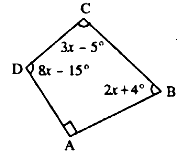
Use the information given in the following figure to find :
(i) x
(ii) ∠B and ∠C
Mr. Mehra gave one-third of his money to his son, one-fifth of his money to his daughter, and the remaining amount to his wife. If his wife got $Rs. 91,000,$ how much money did Mr. Mehra have originally?
The sum of three consecutive numbers is 54. Taking the middle number as x, find:

(i) expression for the smallest number and the largest number.

(ii) the three numbers.

When Ajit travelled 15 km, he found that one-fourth of his journey was still left. What was the full length of the journey?
Using ruler and a pair compass only, construct a triangle PQR, given PQ = 5.5 cm, QR = 7.5 cm and RP = 6 cm. Draw the bisectors of the interior angles at P, Q and R. Do these bisectors meet at the same point ?
Air is an important inexhaustible natural resource. It is essential for the survival of human beings, microbes, plants, and animals. The following table shows the percentage of various gases in the air.
Contents of air Percentage (by volume)
Nitrogen $78$
Oxygen $21$
Other (carbon dioxide, inert gases, water vapours, etc.) $1$

In $800\ m^3$ of air, calculate the approximate quantities of nitrogen, oxygen, and other gases.
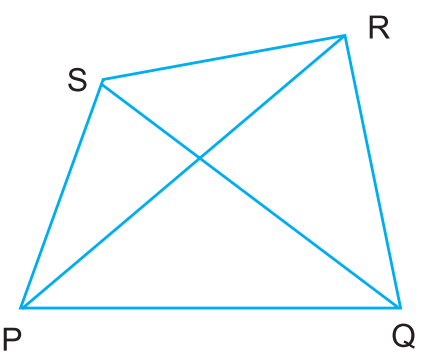
In the adjoining figure, PQRS is a quadrilateral:
Name a pair of its adjacent sides.
Name a pair of its opposite sides.
Name a pair of its adjacent angles.
Name a pair of its opposite angles.
Name its diagonals.
Image
Using the data, given below, construct a frequency distribution table:
9, 17, 12, 20, 9, 18, 25, 17, 19, 9, 12, 9, 12, 18, 17, 19, 20, 25, 9 and 12.
Now answer the following:
(i) How many numbers are less than 19?
(ii) How many numbers are more than 20?
(iii) Which of the numbers, given above, is occurring most frequently?