MCQ
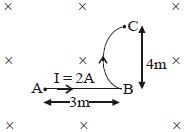
In the given figure force on wire $ABC$ will be $(B = 2T)$
  • A
    $4(3+2\pi ) N$
  • $20\,N$
  • C
    $10\,N$
  • D
    $40\,N$

Answer

Correct option: B.
$20\,N$
b
Force an $\mathrm{AB}=\mathrm{BI} \ell=12 \mathrm{\,N}$ (upward)

Force on $\mathrm{BC}=16 \mathrm{\,N}$ (left)

so force on $\mathrm{ABC}=\sqrt{(12)^{2}+(16)^{2}}=20 \mathrm{\,N}$

Need a full question paper?

Generate a complete, print-ready paper with questions like this in minutes — across 16+ boards, with answer keys.

Start Generating Free

Similar questions

In an $AC$ generator, a coil with $N$ turns, all of the same area $A$ and total resistance $R$, rotates with frequency $\omega$ in a magnetic field $B$. The maximum value of emf generated in the coil is
One yard in $SI$ units is equal
Light enters from air into a given medium at an angle of $45^{\circ}$ with interface of the air-medium surface. After refraction, the light ray is deviated through an angle of $15^{\circ}$ from its original direction. The refractive index of the medium is.
Monochromatic light of frequency $6 \times 10^{14} \mathrm{~Hz}$ is produced by a laser. The power emitted is $2 \times 10^{-3} \mathrm{~W}$. How many photons per second on an average, are emitted by the source?

(Given $\mathrm{h}=6.63 \times 10^{-34} \mathrm{Js}$ )
The magnitude of the de-Broglie wavelength $(\lambda)$ of electron $(e)$, proton $(p)$, neutron $(n)$ and $\alpha-$ particle $(\alpha)$ all having the same energy of $1\,MeV$, in the increasing order will follow the sequence
Sound wave travels with a velocity of $300\, m\, s^{-1}$ through a gas. $9\, beats$ are produced in $3\, s$ when two waves pass through it simultaneously. If one of the waves has $2\, m$ wavelength, the wavelength of the other wave is ..... $m$
Two liquids $A$ and $B$ are at $32°C$ and $24°C$. When mixed in equal masses the temperature of the mixture is found to be $28°C$. Their specific heats are in the ratio of
A particle is performing simple harmonic motion with amplitude A and angular velocity ${\omega }$. The ratio of maximum velocity to maximum acceleration is
In a $dc$ motor, induced $e.m.f.$ will be maximum 
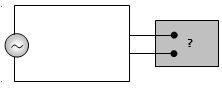
Following figure shows an ac generator connected to a "block box" through a pair of terminals. The box contains possible $R, L, C$ or their combination, whose elements and arrangements are not known to us. Measurements outside the box reveals that $e = 75\, sin\, (sin\, \omega\, t)\, volt,\, i = 1.5\, sin\, (\omega\, t + 45^o)\, amp$ then, the wrong statement is