MCQ
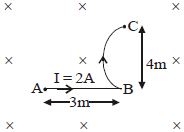
In the given figure force on wire $ABC$ will be $(B = 2T)$
  • A
    $4(3+2\pi ) N$
  • $20\,N$
  • C
    $10\,N$
  • D
    $40\,N$

Answer

Correct option: B.
$20\,N$
b
Force an $\mathrm{AB}=\mathrm{BI} \ell=12 \mathrm{\,N}$ (upward)

Force on $\mathrm{BC}=16 \mathrm{\,N}$ (left)

so force on $\mathrm{ABC}=\sqrt{(12)^{2}+(16)^{2}}=20 \mathrm{\,N}$

Need a full question paper?

Generate a complete, print-ready paper with questions like this in minutes — across 16+ boards, with answer keys.
Start Generating Free

Similar questions

Add vectors $\overrightarrow{ A }, \overrightarrow{ B }$ and $\overrightarrow{ C }$ each having magnitude of $50$ unit and inclined to the $X$-axis at angles $45^{\circ}, 135^{\circ}$ and $315^{\circ}$ respectively.
$7$ mole of certain monoatomic ideal gas undergoes a temperature increase of $40 K$ at constant pressure. The increase in the internal energy of the gas in this process is$....J$ (Given $R =8.3 JK ^{-1} mol ^{-1}$ )
Students $A, B$ and $C$ measure the length of a room using $25 \,m$ long measuring tape of least count $0.5 \,cm$, meter-scale of least count $0.1 \,cm$ and a foot-scale of least count $0.05 \,cm$, respectively. If the specified length of the room is $9.5 \,m$, then which of the following students will report the lowest relative error in the measured length?
If a radioactive substance reduces to $\frac{1}{{16}}$ of its original mass in $40$ days, what is its half-life .........$days$
Wave equations of two particles are given by ${y_1} = a\sin (\omega \,t - kx)$, ${y_2} = a\sin (kx + \omega \,t)$, then
The equation for spherical progressive wave is (where $r$ is the distance from the source) 
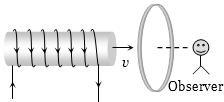
A current carrying solenoid is approaching a conducting loop as shown in the figure. The direction of induced current as observed by an observer on the other side of the loop will be
The unit of "impulse per unit area" is same as that of
Light from a point source falls on a small area placed perpendicular to the incident light. If the area is rotated about the incident light by an angle of $60^o$, by what fraction will the illuminance change
An observer moves towards a stationary source of sound with a speed $1/5^{th}$ of the speed of sound. The wavelength and frequency of the source emitted are $\lambda $ and $f$ respectively. The apparent frequency and wavelength recorded by the observer are respectively