Question
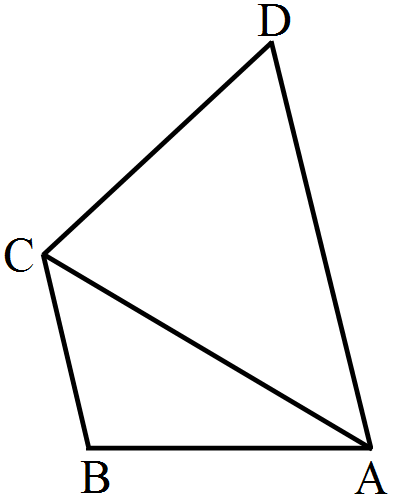
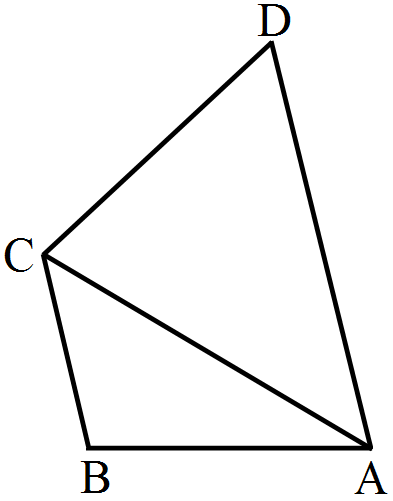
In the given figure, prove that
  1. CD + DA + AB > BC
  2. CD + DA + AB + BC > 2AC.
​​​​​​​

Answer


Given: Quadrilateral ABCD
To prove:
  1. CD + DA + AB > BC
  2. CD + DA + AB + BC > 2AC
Proof:
  1. In $\triangle\text{ACD},$
$\text{CD + DA > CA }...(1)$

In $\triangle\text{ABC,}$

$\text{AB + CA > BC }...(2)$

Adding (1) and (2), we get

$\text{CD + DA + AB +CA > CA + BC}$

$\therefore\text{AB + CD + DA + BC}$
  1. In $\triangle\text{CDA,}$
$\text{CD + DA + >CA }...(3)$

In $\triangle\text{BCA},$

$\text{BC + AB + CA }...(4)$

Adding (3) and (4), we get

$\text{CD + AD + BC + AB > CA + CA}$

$\therefore\text{CD + AD + BC + AB > 2CA}$

Need a full question paper?

Generate a complete, print-ready paper with questions like this in minutes — across 16+ boards, with answer keys.


Start Generating Free

Similar questions

Using the data In example (3) above, prepare less than type cumulative frequency table and answer the following questions.
i. How many students obtained less than 40 marks?
ii. How many students obtained less than 10 marks?
iii. How many students obtained less than 60 marks?
iv. Find the cumulative frequency of the class 50 – 60.
The calculated mean of $50$ observations was $80.$ It was later discovered that observation $19$ was recorded by mistake as $91.$ What Was the correct mean?
The following table shows the number of Buses and Trucks in nearest lakh units. Draw percentage bar diagram. (Approximate the percentages to the nearest integer)
If the mean of the following data is 20.2, then find the value of p.

Image

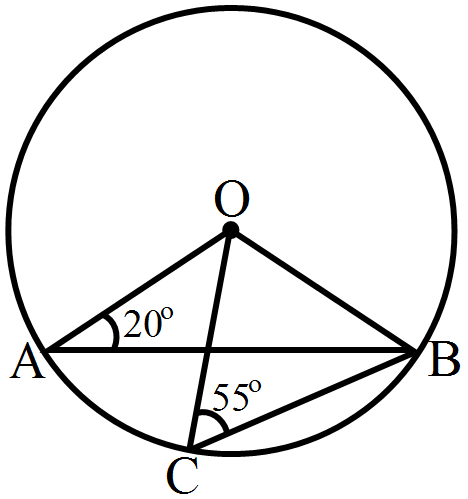
In the given figure, O is the centre of a circle in which $\angle\text{OAB}=20^\circ$and $\angle\text{OCB}=55^\circ.$ Find
  1. $\angle\text{BOC}$
  2. $\angle\text{AOC}$
In a $\triangle\text{ABC},\angle\text{ABC}=\angle\text{ACB}$ and the bisectors of $\angle\text{ABC}$ and $\angle\text{ACB}$ intersect at O such that $\angle\text{BOC}=120^\circ.$ Show that $\angle\text{A}=\angle\text{B}=\angle\text{C}=60^\circ.$
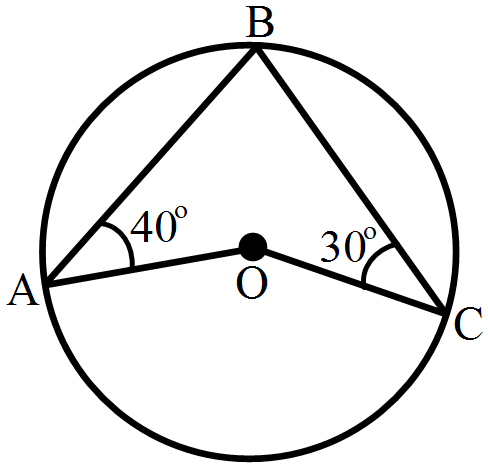
  1. In Figure (1), O is the centre of the circle. If $\angle\text{OAB}=40^\circ$ and $\angle\text{OCB}=30^\circ,$ find $\angle\text{AOC}.$
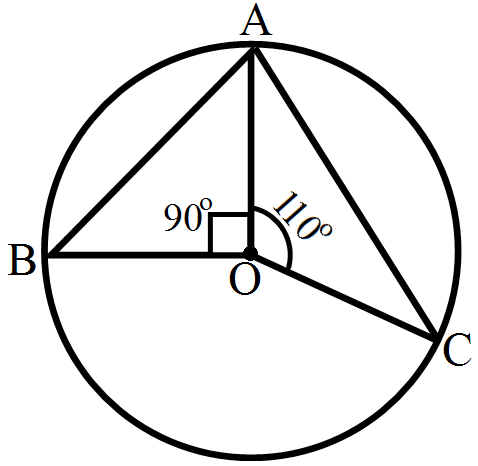
  2. In Figure (2), A, B and C are three points on the circle with centre O such that $\angle\text{AOB}=90^\circ$ and $\angle\text{AOC}=110^\circ.$ Find $\angle\text{BAC}.$


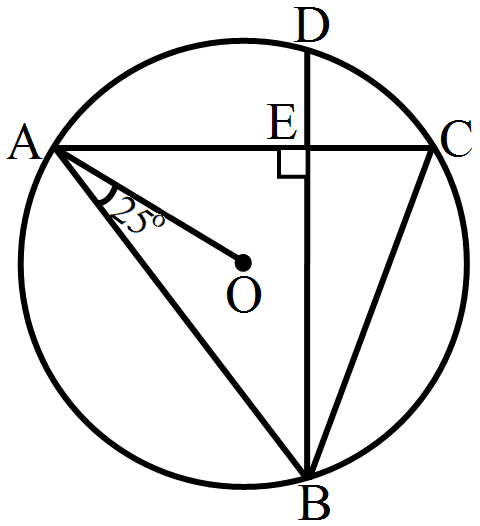
In the adjoining figure, chords AC and BD of a circle with centre O, intersect at right angles at E. If $\angle\text{OAB}=25^\circ,$ calculate $\angle\text{EBC}.$
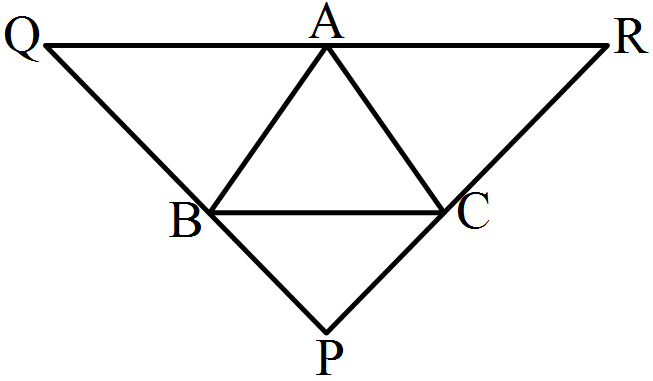
In the adjoining figure, $\triangle\text{ABC}$ is a triangle and through A, B, C, lines are drawn, parallel respectively to BC, CA and AB, intersecting at P, Q and R. Prove that the perimeter of $\triangle\text{PQR}$ is double the perimeter of $\triangle\text{ABC}.$
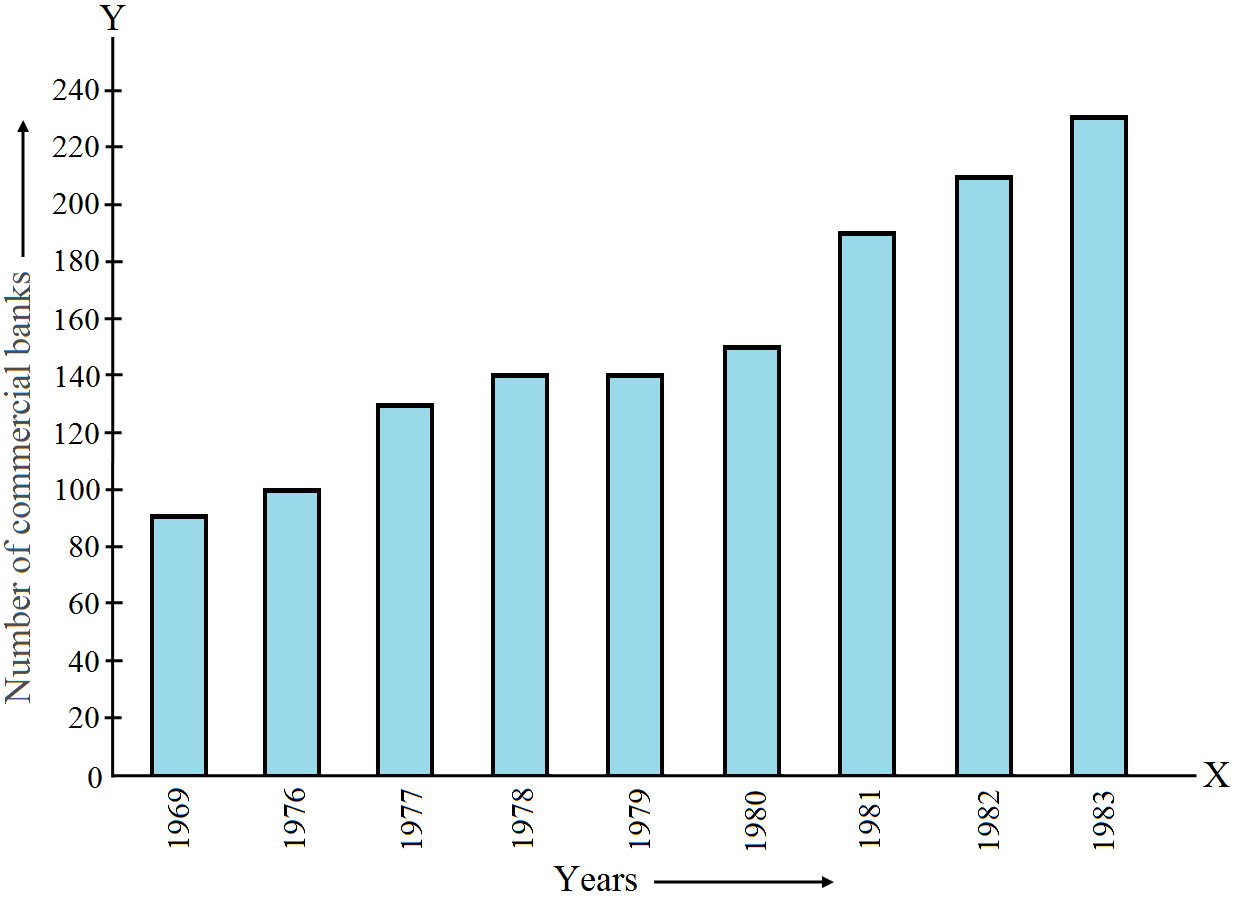
Read the bar graph shown in the figure and answer the following questions:
  1. What is the information given by the bar graph?
  1. What was the number of commercial banks in 1977?
  2. What is the ratio of the number of commercial banks in 1969 to that in 1980?
  3. State whether true or false:
The number of commercial banks in 1983 is less than double the number of commercial banks in 1969.