Question
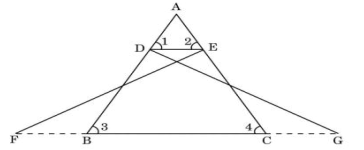
In the given figure, $\triangle FEC \cong \triangle GDB$ and $\angle 1=\angle 2$. Prove that $\triangle ADE \sim \triangle ABC$.
Image

Answer

$\Delta FEC \cong \Delta GDB$
Therefore, $\angle 3=\angle 4$
In $\triangle ABC$,
$\angle 3 =\angle 4$
$\therefore AB =AC.......(i)$
In $\triangle ADE , \angle 1=\angle 2$
$AD=AE......(ii)$
Dividing $(ii)$ by $(i)$
$\frac{AD}{AB}=\frac{AE}{AC}$
$\Rightarrow DE \| BC$
$\angle 1=\angle 3 \text { and } \angle 2=\angle 4$
$\therefore \triangle ADE \sim \triangle ABC$

Need a full question paper?

Generate a complete, print-ready paper with questions like this in minutes — across 16+ boards, with answer keys.

Start Generating Free

Similar questions

A bag contains 6 red balls and some blue balls. if the probability of a drawing a blue ball from the bag is twice that of a red ball, find the number of blue balls in the bag.
If $\alpha$ and $\beta$ are the zeroes of the quadratic polynomial $f(x) = ax^2 + bx + c$, find evaluate:$\frac{\beta}{\text{a}\alpha+\text{b}}+\frac{\alpha}{\text{a}\beta+\text{b}} $
If (0, -3) and (0, 3) are the two vertices of an equilateral triangle, find the coordinates of its third vertex.
The following table shows the cumulative frequency distribution of marks of 800 students in an examination:
Marks Number of students
Below 10 10
Below 20 50
Below 30 130
Below 40 270
Below 50 440
Below 60 570
Below 70 670
Below 80 740
Below 90 780
Below 100 800
Construct a frequency distribution table for the data above.
Find the median from the following data:
Marks
No. of students
Below 10
12
Below 20
32
Below 30
57
Below 40
80
Below 50
92
Below 60
116
Below 70
164
Below 80
200
Find the number of metallic circular disc with 1.5cm base diameter and of height 0.2cm to be melted to form a right circular cylinder of height 10cm and diameter 4.5cm.
A sum of ₹ 700 is to be used to give seven cash prizes to students of a school for their overall academic performance. If each prize is ₹ 20 less than its precending prize, find the value of each prize.
Find the ratio in which the point $\text{P}\Big(\frac{3}{4},\frac{5}{12}\Big)$ divides the line segment joining the points $\text{A}\Big(\frac{1}{2},\frac{3}{2}\Big)$ and B(2, -5).
Prove that $\frac{1}{(sec\theta-\tan\theta)}-\frac{1}{\cos\theta}=\frac{1}{\cos\theta}-\frac{1}{(\sec\theta+\tan\theta)}.$
A 1.5 m tall boy is standing at some distance from a 30 m tall building. The angle of elevation from his eyes to the top of the building increases from 30° to 60° as he walks towards the building. Find the distance he walked towards the building.