Question
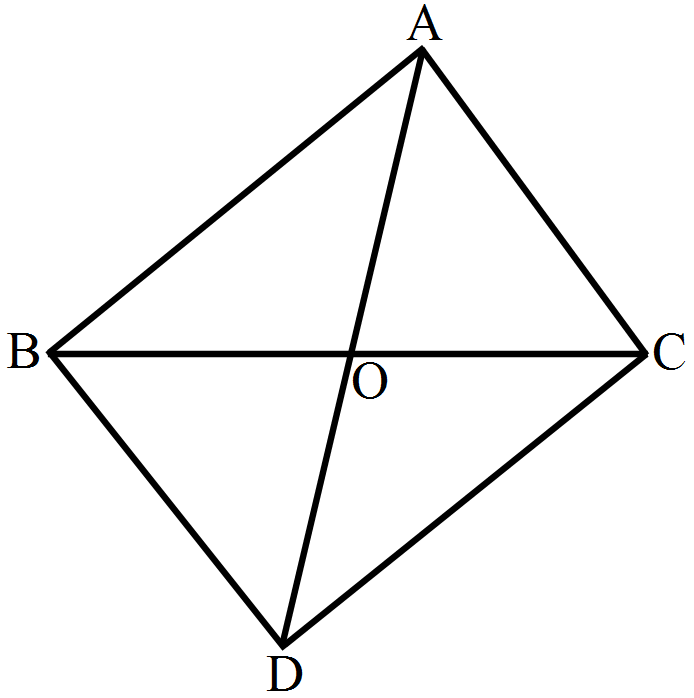
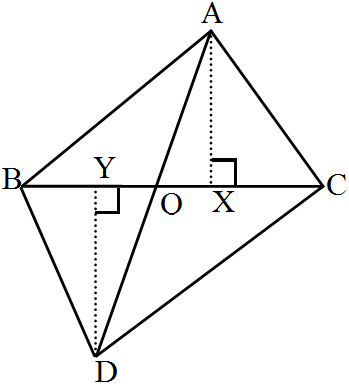
In the given figure, $\triangle\text{ABC}$ and $\triangle\text{DBC}$ have the same base BC. If AD and BC intersect at O, prove that $\frac{\text{ar}(\triangle\text{ABC})}{\text{ar}(\triangle\text{DBC})}=\frac{\text{AO}}{\text{DO}}.$
Answer


Construction: Draw $\text{AX}\perp\text{CO}$ and $\text{DY}\perp\text{BO}.$
As,
$\frac{\text{ar}(\triangle\text{ABC})}{\text{ar}(\triangle\text{DBC})}=\frac{\frac{1}{2}\times\text{AX}\times\text{BC}}{\frac{1}{2}\times\text{DY}\times\text{BC}}$
$\Rightarrow\frac{\text{ar}(\triangle\text{ABC})}{\text{ar}(\triangle\text{DBC})}=\frac{\text{AX}}{\text{DY}}\dots(\text{i})$
In $\triangle\text{ABC}$ and $\triangle\text{DBC},\angle\text{AXY}=\angle\text{DYO}=90^\circ(\text{By construction})$
$\angle\text{AOX}=\angle\text{DOY}(\text{Vertically opposite angles})$$\therefore\triangle\text{AXY}\sim\triangle\text{DYO }(\text{By AA criterion})$
This completes the proof.

Need a full question paper?

Generate a complete, print-ready paper with questions like this in minutes — across 16+ boards, with answer keys.

Start Generating Free

Similar questions

If the sum of first $6$ terms of an $A.P$. is $36$ and that of the first $16$ terms is $256,$ find the sum of first $10$ terms.
A train covered a certain distance at a uniform speed. If it were $6 \ km/h$ faster, it would have taken $4$ hours less than the scheduled time. And, if the train were slower by $6 \ km/h,$ it would have taken $6$ hours more than the scheduled time. Find the length of the journey.
Find the mean of the following data, using direct method:
Class
0-10
10-20
20-30
30-40
40-50
50-60
Frequency
7
5
6
12
8
2
If the roots of the equation $\left(c^2-a b\right) x^2-2\left(a^2-b c\right) x+b Z^2-a c=0$ are equal, prove that either $a=0$ or $a^3+b^3+c^3=3 a b c$.
Two years ago, a man was five times as old as his son. Two years later, his age will be 8 more than three times the ago of the son. Find their present ages.
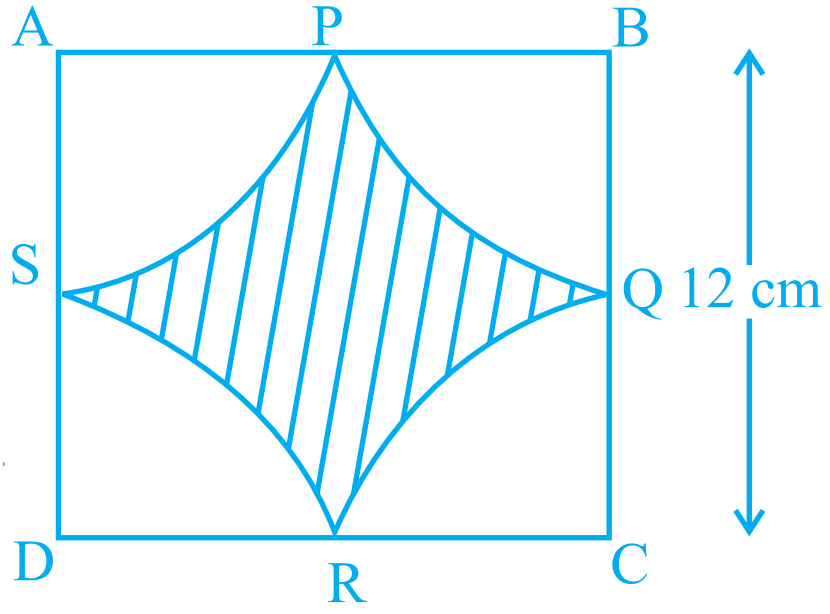
Find the area of the shaded region in Fig. where arcs drawn with centres $\text{A, B, C}$ and $D$ intersect in pairs at mid $-$ points ${\text{P, Q, R}}$ and $S$ of the sides $\text{AB, BC, CD}$ and $DA,$ respectively of a square $\text{ABCD} (\text{Use }\pi=3.14).$
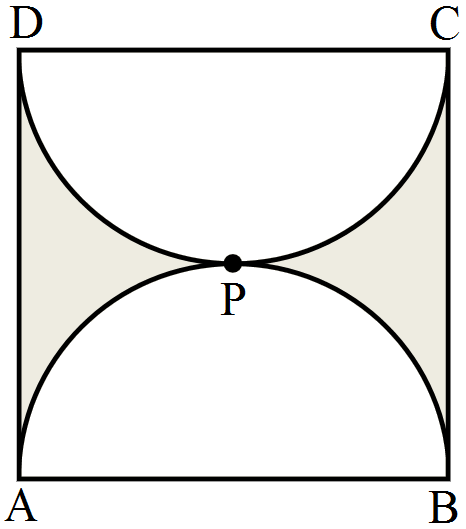
Find the perimeter of the s ded region in the figure, if ABCD is a square of side 14cm and APB and CPD are semicircles.
The time taken by a person to cover 150km was 2.5 hrs more than the time taken in the return journey. If he returned at a speed of 10km/hr more than the speed of going, what was the speed per hour in each direction?
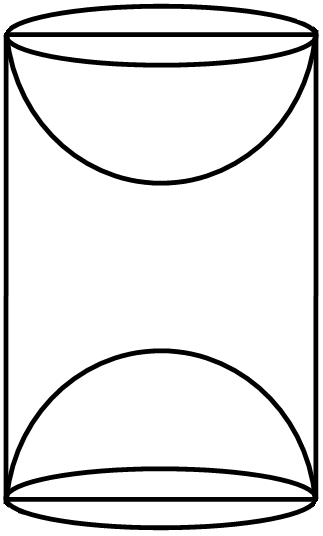
A wooden article was made by scooping out a hemisphere from each end of a cylinder, as shown in the figure. If the height of the cylinder is 20cm and its base is of diameter 7cm, find the total surface area of the article when it is ready.
A chord of a circle of radius 30cm makes an angle of 60° at the centre of the circle. Find the area of the minor and major segments. $\big[\text{Take }\pi=3.14\text{ and }\sqrt{3}=1.732\big]$