Question
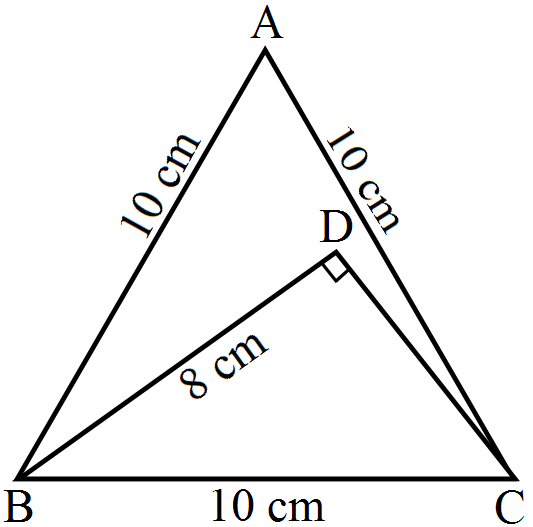
In the given figure, $\triangle\text{ABC}$ is an equilateral triangle the length of whose side is equal to $10\ cm,$ and $\triangle\text{DBC}$ is right-angled at $D$ and $BD = 8\ cm.$ Find the area of the shaded region. $\big[\text{Take}\sqrt{3}=1.41\big]$
Answer

Given:
Side of equilateral $\triangle \text{ABC} = 10\text{cm}$
$BD = 8\ cm$
Area of equilateral $\triangle\text{ABC}=\frac{\sqrt{3}}{4}\text{a}^2 ($where $a = 10\ cm)$
Area of equilateral $\triangle\text{ABC}=\frac{\sqrt{3}}{4}\text{a}^2$
$=25\sqrt{3}$
In the right $\triangle\text{BDC},$ we have:
$BC^2= BD^2+ CD^2$
$\Rightarrow 10^2= 8^2+ CD^2$
$\Rightarrow CD^2= 10^2- 8^2$
$\Rightarrow CD^2= 36$
$\Rightarrow CD = 6$
Area of triangle $\triangle\text{BCD}=\frac12\times\text{b}\times\text{h}$
$=\frac12\times8\times6$
$=24\text{cm}^2$
Area of the shaded region = Area of $\triangle \text{ABC}$ - Area of $\triangle \text{BDC}$
$= 43.30 - 24$
$= 19.3\ cm^2.$

Need a full question paper?

Generate a complete, print-ready paper with questions like this in minutes — across 16+ boards, with answer keys.

Start Generating Free

Similar questions

A copper wire of diameter 6mm is evenly wrapped on a cylinder of length 18cm and diameter 49cm to cover its whole surface. Find the length and the volume of the wire. If the density of the copper be 8.8g per cu-cm, then find the weight of the wire.
The area of an equilateral triangle is $49\sqrt{3}\text{cm}^2.$ taking each angular point as centre, circles are drawn with radius equal to half the length of the side of the triangle. Find the area of the triangle not included in the circles. $\big[\text{Take }\sqrt{3}=1.73\big]$
Prove that $5\sqrt2$ is an irrational number.
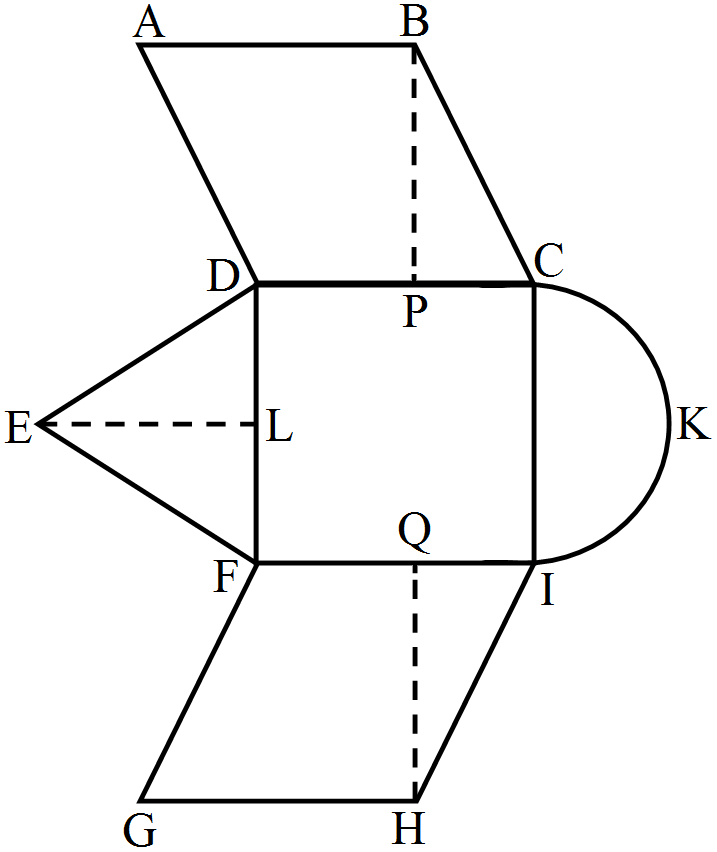
A child draws the figuie of an aeroplane as shown. Here, the wings $ABCD$ and FGHI are parallelograms, the tail $DEF$ is an sosceles triangle, the cockpit $CKI$ is a semicircle and $CDFI$ is a square. In the given figure, $\text{BP}\perp\text{CD},\ \text{HQ}\perp\text{FI}$ and $\text{EL}\perp\text{DF}.$ if $\text{CD}=8\text{cm},\ \text{BP}=\text{HQ}=4\text{cm}$ and $\text{DE}=\text{EF}=5\text{cm},$ find the area of the whole figure. $\big[\text{Take }\pi=3.14\big]$
If $(2\sin\theta+3\cos\theta)=2,$ and $(3\sin\theta-2\cos\theta)=\pm3.$
Solve for x and y:$\frac{5}{\text{x}+\text{y}}-\frac{2}{\text{x}-\text{y}}=-1,$
$\frac{15}{\text{x}+\text{y}}+\frac{7}{\text{x}-\text{y}}=10$
Short-Answer Question:
If the zeroes of a polynomial $f(x) = x^3 - 3x^2+ x + 1$ are $(a - b), a$ and $(a + b),$ find a and $b.$
Solve the following systems of equations by using the method of cross multiplication:
$2ax + 3by = (a + 2b),$
$3ax + 2by = (2a + b).$
Find all the zeros of $(x^4+x^3-23 x^2-3 x+60)$, if it is given that two of its zeros are $\sqrt3$ and $-\sqrt3.$
In a cyclic quadrilateral ABCD, it is given that $\angle\text{A}=(\text{2x}+4)^\circ,\ \angle\text{B}=(\text{y}+3)^\circ,$ $\angle\text{C}=(\text{2y}+10)^\circ$ and $\angle\text{D}=(\text{4x}-5)^\circ$ Find the four angles.