Question
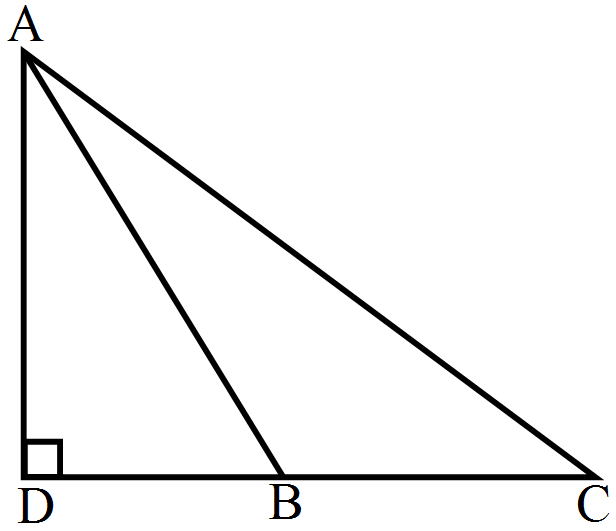
In the given figure, $\triangle\text{ABC}$ is an obtuse triangle, obtuse-angled at B. If $\text{AD}\perp\text{CB}$ (produced) prove that $AC^2 = AB^2+ BC^2 +2BC.BD.$
Answer


Applying Pythagoras theorem in right-angled triangle ADC, we get:
$AC^2= AD^2 + DC^2$
$\Rightarrow AC^2 - DC^2 = AD^2$
$\Rightarrow AD^2 = AC^2- DC^2 .....(1)$
Applying Oythagoras theorem in right-triangle ADB, we get:
$AB^2 = AD^2 + DB^2$
$\Rightarrow AB^2 - DB^2= AD^2$
$\Rightarrow AD^2 = AB^2 - DB^2 .....(2)$
From equation (1) and (2), we have:
$AC^2 - DC^2 = AB^2 - DB^2$
$\Rightarrow AC^2 = AB^2 + DC^2 - DB^2$
$\Rightarrow AC^2 = AB^2 + (DB + BC)^2- DB^2$ $(\therefore\text{DB}+\text{BC}=\text{DC})$
$\Rightarrow AC^2 = AB^2 + DB^2 + BC^2 + 2DB.BC - DB^2$
$\Rightarrow AC^2 = AB^2 + BC^2 + 2BC.BD$
This completes the proof.

Need a full question paper?

Generate a complete, print-ready paper with questions like this in minutes — across 16+ boards, with answer keys.
Start Generating Free

Similar questions

Find the common difference of an A.P. whose first term is 5 and the sum of its first four terms is half the sum of the next four terms.
Show graphically that each of the following given systems of equations is inconsistent, i.e., has no solutions:
2x + y = 6, 6x + 3y = 20
Show taht the following points are collinear:A(8, 1), B(3, -4) and C(2, -5)
A wooden article was made by scooping out a hemisphere from each end of a solid cylinder, as shown in the figure. If the height of the cylinder is 5.8 cm and its base is of radius 2.1 cm , find the total surface area of the article.
Image
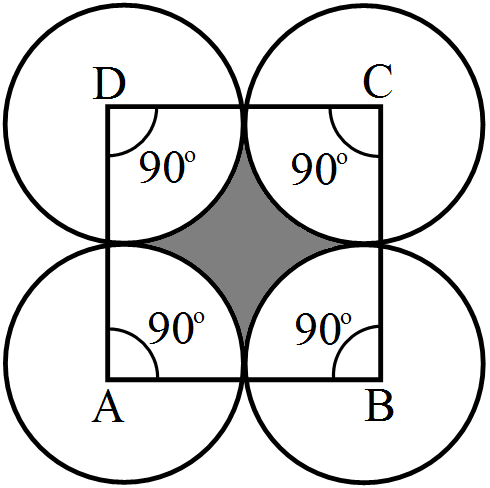
Four equal circles are described about the four corners of a square so that each touches two of the others, as shown in the figure. find the area of the shaded region, if each side of the square measures 14cm. $\Big[\text{Use }\pi=\frac{22}{7}\Big]$
Find the second term and $n ^{\text {th }}$ term of an A.P. whose $6^{\text {th }}$ term is 12 and $8^{\text {th }}$ term is 22.
If 10 times the $10^{\text {th }}$ term of an AP is equal to 15 times the $15^{\text {th }}$ term, show that its $25^{\text {th }}$ term is zero.
Find the roots of the following equations, if they exist, by applying the quadratic formula:$x^2 + x + 2 = 0$
Find the sum of all even integers between 101 and 999.
Draw a right triangle in which sides (other than the hypotenuse) are of lengths 8cm and 6cm. Then construct another triangle whose sides are $\frac{3}{4}$ times the corresponding sides of the first triangle.