MCQ
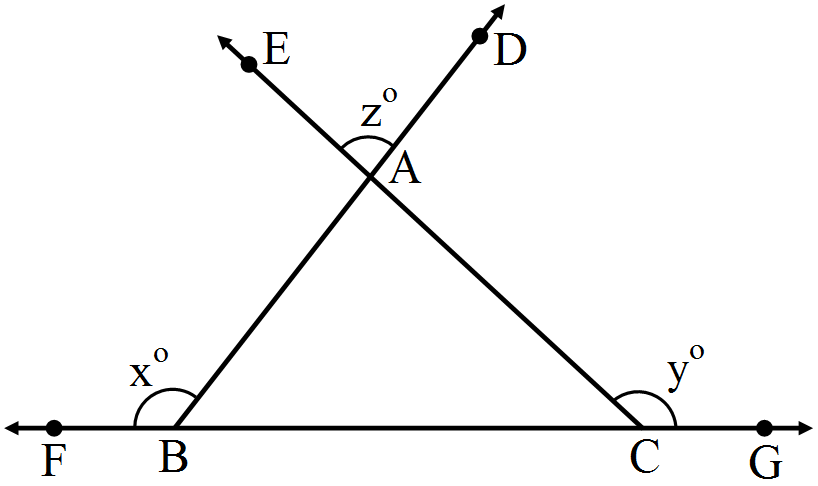
In the given figure, two rays $BD$ and $CE$ intersect at a point $A$. The side $BC$ of $\triangle\text{ABC}$ have been produced on both sides to points $F$ and $G$ respectively. If $\angle\text{ABF}=\text{x}^\circ,\angle\text{ACG}=\text{y}^\circ$ and $\angle\text{DAE}=\text{z}^\circ$ then $z =$ ?​​​​​​​
  • $x + y - 180^\circ$
  • B
    $x + y + 180^\circ$
  • C
    $180^\circ - (x + y)$
  • D
    $x + y + 360^\circ $

Answer

Correct option: A.
$x + y - 180^\circ$
$\angle\text{ABF}+\angle\text{ABC}=180^\circ \ ($linear pair$)$
$\Rightarrow\text{x}+\angle\text{ABC}=180^\circ$
$\Rightarrow\angle\text{ABC}=180^\circ-\text{x}$
$\angle\text{ACG}+\angle\text{ACB}=180^\circ \ ($linear pair$)$
$\Rightarrow\text{y}+\angle\text{ACB}=180^\circ$
$\Rightarrow\angle\text{ACB}=180^\circ-\text{y}$
In $\triangle\text{ABC},$ by angle sum property
$\angle\text{ABC}+\angle\text{ACB}+\angle\text{BAC}=180^\circ$
$\Rightarrow(180^\circ-\text{x})+(180^\circ-\text{y})+\angle\text{BAC}=180^\circ$
$\Rightarrow\angle\text{BAC}-\text{x}-\text{y}+180^\circ=0$
$\Rightarrow\angle\text{BAC}=\text{x}+\text{y}-180^\circ$
Now, $\angle\text{EAD}=\angle\text{BAC}\ ($vertically opposite angles$)$
$\Rightarrow\text{z}=\text{x}+\text{y}-180^\circ$

Need a full question paper?

Generate a complete, print-ready paper with questions like this in minutes — across 16+ boards, with answer keys.

Start Generating Free