MCQ
In the given graph, the feasible region for a LPP is shaded. The objective function $Z=2 x-3 y$, will be minimum at
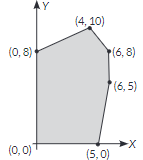
Image
  • A
    $(4,10)$
  • B
    $(6,8)$
  • C
    $(0,8)$
  • D
    $(6,5)$

Answer

We have,
Corner pointsValue of Z=2x-3y
(0,0)2xx0-3xx0=0
(0,8)2xx0-3xx8=-24 (Minimum)
(4,10)2xx4-3xx10=-22
(6,8)2xx6-3xx8=-12
(6,5)2xx6-3xx5=-3
(5,0)2xx5-3xx0=10
$\therefore \quad$ Value of $Z$ is minimum at $(0,8)$.

Need a full question paper?

Generate a complete, print-ready paper with questions like this in minutes — across 16+ boards, with answer keys.

Start Generating Free

Similar questions

If $f (x) =$ $\left[ \begin{gathered}  {x^2}\,\,\,\,\,\,\,\,\,\,\,\,if\,\,\,\,x \leqslant \,{x_0} \hfill \\   ax + b\,\,\,\,\,if\,\,\,\,x\, > \,{x_0} \hfill \\ \end{gathered}  \right.$ derivable $\forall \,x\, \in \,R\,\,$ then the values of $a$ and $b$ are respectively
If the function $f(x)=\left\{\begin{array}{cc}(1+|\cos x|) \frac{\lambda}{|\cos x|} & , 0 < x < \frac{\pi}{2} \\ \mu & , x=\frac{\pi}{2} \\ e^{\frac{\cot 6 x}{\cot 4 x }} & , \frac{\pi}{2} < x < \pi\end{array}\right.$ is continuous at $x =\frac{\pi}{2}$, then $9 \lambda+6 \log _{ e } \mu+\mu^6- e ^{6 \lambda}$ is equal to
The equation of line $x + y + z -1 = 0 = 4x + y -2z + 2$ written in the symmetrical form is where

$(A)$ $ \equiv \frac{{x + 1}}{1} = \frac{{y - 2}}{{ - 2}} = \frac{{z - 0}}{1}$

$(B)$ $ \equiv \frac{x}{1} = \frac{y}{{ - 2}} = \frac{{z - 1}}{1}$

$(C)$ $ \frac{{x + 1/2}}{1} = \frac{{y - 1}}{{ - 2}} = \frac{{z - 1/2}}{1}$

If $\int\frac{3\text{x}+4}{\text{x}^3-2\text{x}-4}\text{dx}=\log|\text{x}-2|+\text{k}\log\text{f(x)}+\text{c},$ then:
  1. f(x) = |x² + 2x + 2|
  2. f(x) = x² + 2x + 2
  3. $\text{k}=-\frac{1}{2}$
  4. All of these
The direction cosines of the y-axis are:
  1. (9, 0, 0)
  2. (1, 0, 0)
  3. (0, 1, 0)
  4. (0, 0, 1)
If the function $f(x) = {x^3} - 6{x^2} + ax + b$ satisfies Rolle’s theorem in the interval $[1,\,3]$ and $f'\left( {{{2\sqrt 3 + 1} \over {\sqrt 3 }}} \right) = 0$, then $a =$ ..............
If A is an invertible matrix, then det (A-1) is equal to:
  1. Det (A)
  2. $\frac{1}{\text{det(A)}}$
  3. 1
  4. None of these.
A primitive of $f(x) = \frac{x}{{1 + {x^2}}}$  $dx$=
For the equation ${\cos ^{ - 1}}x + {\cos ^{ - 1}}2x + \pi = 0$, the number of real solution is
If A and B are two independent events with $\text{P(A)}=\frac{3}{5}$ and $\text{P(B)}=\frac{4}{9},$ then $\text{P}(\overline{\text{A}}\cap\overline{\text{B}})$ equals,
  1. $\frac{4}{15}$
  2. $\frac{8}{45}$
  3. $\frac{1}{3}$
  4. $\frac{2}{9}$