MCQ
In the given pair identify most acidic compound in $(A)$ and $(B)$. Most basic in $(C)$ and $(D)$.
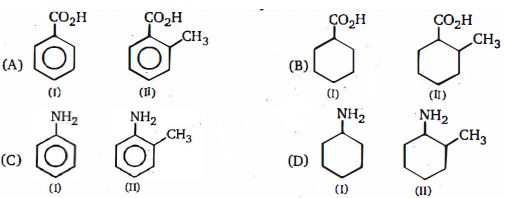
- A$A - I, B - II, C - I, D - II$
- ✓$A - II, B - I, C - I, D - II$
- C$A - II, B - II, C - II, D - II$
- D$A - I, B - II, C - I, D - I$
$2,6 - di - Me (pK_a \,3.21) > 2 - t - Bu \,(pK_a \,3.46) > 2 - Me \,(pK_a\, 3.91)$.
Here again, if we consider the stability of the anion, steric inhibition of resonance prevents the $+ R$ effect of the ring coming into operation (see above), and since this weakens acid strength, its absence results in increased acid strength.
For options $B$ and $D$, no ortho effect is valid and order of acidity and basicity is calculated by nearly examining the inductive effect.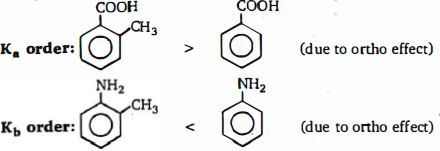
Generate a complete, print-ready paper with questions like this in minutes — across 16+ boards, with answer keys.
| Element | $IE_1$ | $IE_2$ | $IE_3$ | $IE_4$ |
| $W$ | $10.5$ | $15.5$ | $24.9$ | $79.8$ |
| $X$ | $8$ | $14.8$ | $78.9$ | $105.8$ |
Other two elements $Y$ and $Z$ have outer electronic configuration $ns^2$ $np^4$ and $ns^2$ $np^5$ respectively. According to given information which of the following compound $(s)$ is/are not possible
$(a)\, W_2Y_3\, (b)\, X_2Y_3\, (c)\, WZ_2\, (d)\, XZ_2$
$\mathop C\limits^\Theta {H_3},\mathop N\limits^\Theta {H_2},\,\mathop O\limits^\Theta H,\,\mathop C\limits^\Theta l$
Product $ X$ is
$(i)$ In pure water
$(ii)$ In presence of $0.1\ M AgNO_3$
$(iii)$ In presence of $2\ M aq.$ solution of $KCN$
$(iv)$ In presence of $ 1\ M aq$. solution of $Ca(CN)_2$
$(v)$ In presence of $2\ M aq.$ solution of $NH_3$
(Assuming $100\%$ dissociation of $AgNO_3, KCN$ and $Ca(CN)_2)$ and complex formation with $NH_3$ and $CN^-$ will take place.